
Trump Tariff Calculator: Cost of US Goods Simulator From All Tariffed Countries in 2026
Note: This is a speculative tool based on the latest tariff data. Actual prices may vary due to market dynamics, retailer pricing strategies, or further policy changes. Always check official sources for the most current tariff rates.
{“type”:”elementor”,”siteurl”:”https://speedcommerce.com/wp-json/”,”elements”:[{“id”:”07b9c12″,”elType”:”widget”,”isInner”:false,”isLocked”:false,”settings”:{“editor”:”
Looking for a better fulfillment solution?
A fulfillment expert will get back to you within 1-2 business days.
How to Use the Trump Tariff Calculator
Our calculator is designed to help you estimate the cost of goods under the new 2025 tariffs, based on data from the US trade policy changes. It’s simple to use and provides real-time calculations for different tariff scenarios. Note that on May 29th, 2025, US courts suspended the application of Trump’s tariffs, and then the following day (May 30th) paused that suspension of tariffs, including those levied on Canada and Mexico, on a blanket 10% tariff levied on most trading partners, on reciprocal tariffs, as well as China’s ‘fentanyl’ tariffs.
A lower court ruled that former President Trump didn’t have the power under emergency laws to impose his 15% tariffs on many imports, saying only Congress can set taxes. However, a higher appeals court quickly put that ruling on hold, meaning the tariffs stay in place for now while the government appeals.
Who are we? Speed Commerce is an end-to-end provider of outsourced customer experience solutions for eCommerce retailers (including for Shopify and BigCommerce and more) as well as manufacturers, for close to 20 years. We grow our clients’ businesses by providing winning customer experience strategies such as 24/7/365 eCommerce customer service, order fulfillment, and warehousing – get a free quote from a fulfillment expert. Use our new DIM weight calculator, optimized for 2025.
Why Use Our Loading Calculator?
1. Select the Country of Origin
Choose the country where your goods are made or imported from using the dropdown menu. This matters as tariff rates vary by country (e.g., China faces a 30% tariff, while most others face 10%).
The calculator includes data for over 150 countries, reflecting the tariff rates from the provided dataset
2. Enter the Cost of Goods
- Input the current cost of your goods (in USD) in the “Cost of Goods” field. For example, if a phone costs $500, enter that amount.
- Ensure the value is non-negative; the calculator prevents invalid inputs.
3. Enter the Quantity
Specify the number of items in the “Quantity of Goods” field. For instance, if you’re importing 10 phones, enter “10.”
Like the cost field, only non-negative numbers are accepted.
4. Review the Results
The calculator instantly displays four scenarios
Zero Tariff (Pre-2025) – The cost without any tariffs (Cost × Quantity).
Previous Rate (Full Effect) – The cost with the previous tariff rate applied fully (e.g., 34% for China before 2025).
Previous Rate (50% Effect) – The cost assuming only 50% of the previous tariff is passed to you.
Updated Rate (Full Effect) – The cost with the current 2025 tariff rate (e.g., 125% for China).
Results are formatted to two decimal places for clarity (e.g., $500.00).
5. Experiment with Scenarios
- Try different countries, costs, or quantities to see how tariffs affect your expenses. For example, compare importing from China (125% tariff) versus Japan (10% tariff).
- The calculator updates in real-time as you change inputs, making it easy to test multiple scenarios.
List of Trump Tariffs by Country: Calculator Values Based on Latest Tariff Data Available as of May 13th, 2025
Trump Tariff Calculation Method
As we’re on the subject of calculating costs for importers and consumers, we need to take a step back and address some of the discussion around how the administration calculated the base and reciprocal tariff rates by country. A few potential issues with the methodology have emerged, including how reciprocal rates are not entirely 1 to 1 in their reciprocity as well as how the administration’s baseline assumptions around the severity of trade imbalances may be the result of a mathematical error. More below.
White‑Paper to White House: Setting the Numbers
US. Dept. of Commerce reports gauged harms (e.g., steel capacity utilization, China’s IP theft) and outlined options—global rates, targeted tariffs, or quotas.
Trump also rounded rates (25 percent steel), delayed consumer‑sensitive tariffs (holiday postponements), or wielded blanket threats (e.g., all‑Mexico tariffs tied to immigration) to maximize leverage.
Meanwhile, Peter Navarro’s deficit‑offset formula (deficit divided by import value, halved for gentler rates, floor of 10 percent) never fully saw the light of day but underscored the administration’s push for simplicity over nuance.
2) Tariff Calculation Method Simulator
Using the Trump administration’s tariff formula, experiment with different inputs to see how the reciprocal tariffs changes in real time. Each input is clearly labeled so you can explore “what‑if” scenarios and understand each step.
Simulated Tariff Rate:
A Flawed Approach Compounded by A Mathematical Error
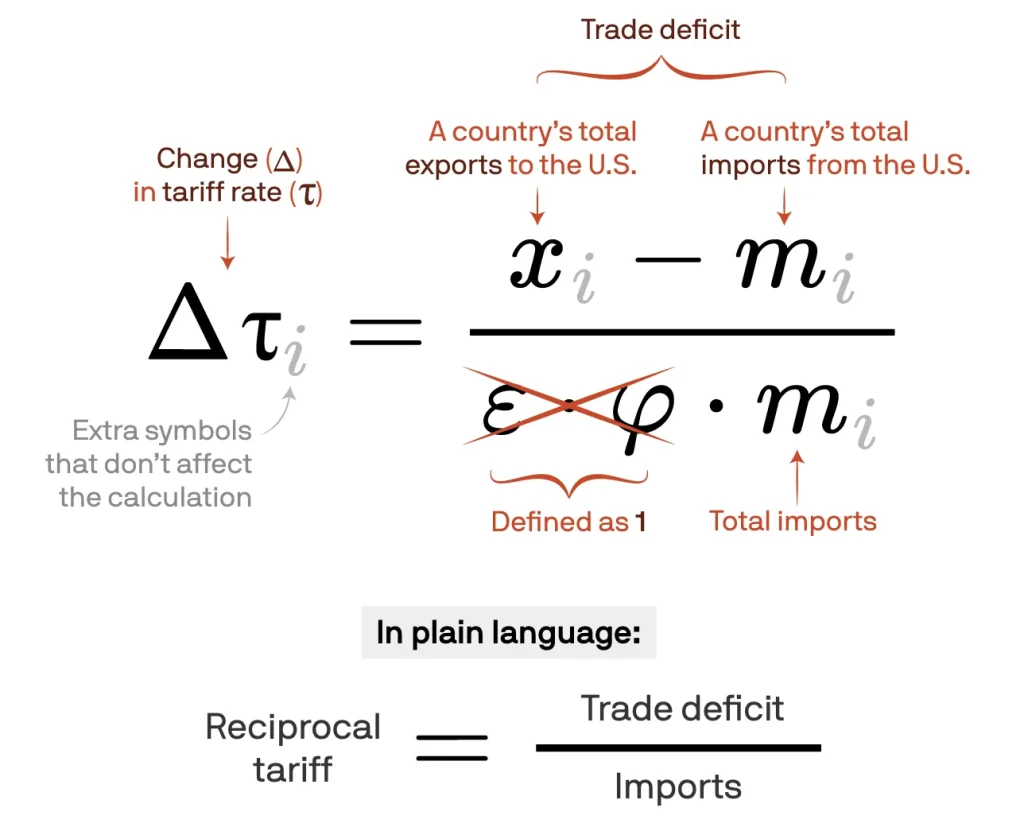
On April 6th 2025, American Enterprise Institute economists pinpointed a flaw in the calculation method: the formula’s two variables cancel out only if you plug in the wrong elasticity.
The tariffs are based on a formula that uses trade deficits (the difference between what the U.S. buys from and sells to a country). The formula divides the trade deficit by total imports, halves it, and sets a tariff rate, with a minimum of 10%.
The AEI found that the formula might be wrong. They suggest the administration accidentally doubled the tariff rates by misapplying a factor meant to account for how price changes affect trade. If corrected, no country’s tariff would be above 14%, compared to rates as high as 50% for some countries under the current plan.
The White House insists the formula is intentional, but AEI argues it’s a calculation error that could lead to unnecessarily high tariffs, raising costs for consumers and risking trade disputes. An annotated version of the Trump teams calculation method is below.
Economists as a result have roundly dismissed the overall approach as nonsensical, arguing it conflates deficits with unfair trade practices and risks harming U.S. consumers (via higher prices) and industries reliant on imports. The conclusion is that the policy is less about economic strategy and more about populist rhetoric, prioritizing punitive measures over trade solutions.
At Speed Commerce, we don’t weigh in on the politics of solutions but we do note the ample amount of debate surrounding complex trade issues and the administration’s response to them.
Fulfillment Calculators By Speed Commerce
Trump Tariff Calculation Method Simulator
Calculate the cubic volume (CBM) of your shipments.
Freight Class Calculator
Quickly estimate total shipment volume, density (calculated in pounds per cubic foot), and freight class, based on the density thresholds.
Shipping Pallet Configuration Calculator
Determine the most efficient way to stack cartons on a pallet by calculating the number of boxes that fit per layer and the total pallet height.
Container Loading Calculator
Quickly determine how many items of specific dimensions can be loaded into standard shipping containers.
Popular Fulfillment Resources From Speed Commerce
Best 3PLs in the USA
The 12 best 3PL companies in the US, ranked.
Third-Party Logistics (3PL)
Outsourcing logistics and supply chain management activities to a provider.
Section 321
Law that allows shipments valued under $800 to enter the U.S. duty-free.
Pick and Pack Fulfillment
The shipping of products from an eCommerce business to a customer on a predetermined schedule.
Frequently Asked Questions About US Tariffs
Q: What is a tariff?
A: A tariff is a tax placed on imported goods to make them more expensive, often used to protect domestic industries or influence trade policies.
Q: How do tariffs affect prices in the US?
A: Tariffs can lead to higher prices for consumers, as importers often pass the added costs onto buyers.
Q: How do US tariffs impact global trade?
A: Tariffs can lead to trade disputes, retaliation from other countries, and disruptions in international supply chains.