

Devanning sounds straightforward, how complicated can unloading a container be? But anyone experienced in logistics knows there’s more to devanning than meets the eye. This overlooked task directly influences your warehouse efficiency and supply chain performance. Let’s explore what devanning entails, how it works, and the hurdles logistics teams face today.
Who are we? Speed Commerce is an end-to-end provider of outsourced customer experience solutions for eCommerce retailers (including for Shopify and BigCommerce and more) as well as manufacturers, for close to 20 years. We grow our clients’ businesses by providing winning customer experience strategies such as 24/7/365 eCommerce customer service, order fulfillment, and warehousing – get a free quote from a fulfillment expert. Use our new tariff calculator, updated for 2026.
What Exactly Is Devanning?
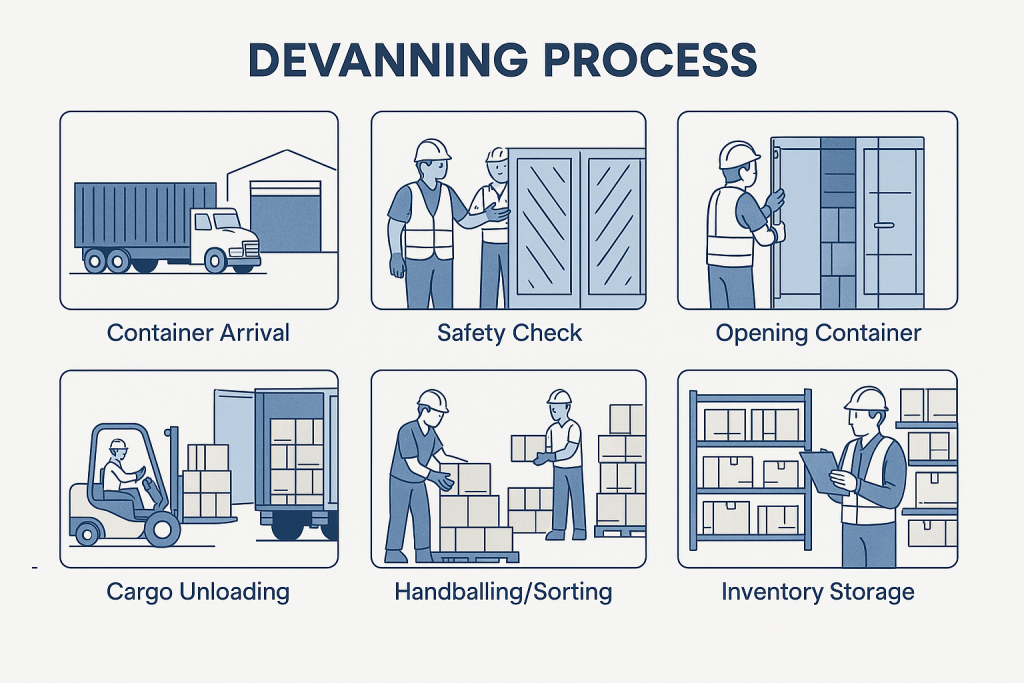
Devanning, sometimes known as unpacking, stripping, or unstuffing, refers to the process of unloading cargo from a sealed shipping container upon arrival at the warehouse. This stage follows drayage—transporting goods from ports to warehouses—and precedes inventory receiving and put-away.
Imagine you’ve ordered 1,500 units of a product from overseas suppliers. Once your shipment arrives at your warehouse dock, your team must carefully unload each unit from the container using specialized equipment like forklifts and conveyors. Each item is inspected, sorted, and prepared for the next step—storage or immediate order fulfillment.
How the Devanning Process Works
When a container reaches the warehouse, devanning typically begins by placing it in a position easily accessible to the warehouse crew—usually at dock level. Before opening the container, the team assesses the safety of the area, checking lighting, stability, and any potential hazards like unsecured cargo.
Using counterbalance forklifts—chosen for their maneuverability and efficiency—the devanning team systematically removes the cargo. Whether the container is floor-loaded (goods directly on the container floor) or pallet-loaded significantly affects the time and effort involved. Floor-loaded containers typically require more manual work, known as handballing, where cargo is physically handled and sorted onto pallets.
On average, devanning can take anywhere from one to three days. Factors like crew experience, shipment type (FCL vs. LCL), and the quality of equipment significantly impact the speed of this critical stage.
Problems in Devanning to Know About
In a a perfect world, devanning would run smoothly, every time. Reality happens though and brings some pitfalls.
Supply Chain Congestion
When disruptions, like those witnessed during global crises or incidents like the Suez Canal blockage—occur, containers pile up, creating congestion. A backlog at the docks translates to significant delays downstream, impacting everything from inventory management to customer deliveries.
Staffing Issues
Devanning isn’t something anyone can casually manage. It demands skilled workers experienced in handling heavy equipment safely and efficiently. Labor shortages can severely slow down the process, especially during handballing when manual labor is most intense.
Stock Labeling and Identification
Different suppliers use various labeling systems. Without standardized labeling, confusion arises, causing misidentification and storage errors. Goods might need relabeling to match the warehouse inventory systems, adding another step and potential bottleneck.
Container Prioritization
Miscommunications can lead to prioritizing the wrong containers, causing essential shipments to wait longer than necessary and leading to ripple effects through the supply chain.
Safety Risks
Operating forklifts and handling heavy cargo introduces inherent safety risks. Even minor oversights can result in costly accidents, damaging goods, and endangering staff.
Best Practices to Optimize Devanning
Fortunatey you can proactively manage devanning complexities with some tried-and-true tactics.
Prioritize safety by maintaining strict protocols—positioning containers safely, ensuring workers use appropriate protective gear, and consistently training staff on safety measures. Clear and well-lit workspaces significantly reduce risks.
Automation can streamline the process. Incorporating technology like barcode scanners or robotic unloading systems speeds up cargo handling, reduces manual labor, and boosts accuracy.
Outsourcing devanning to specialized 3PL providers, such as Speed Commerce, can greatly enhance efficiency. Experienced logistics partners handle the entire devanning process, ensuring accuracy, speed, and safety. This frees your internal resources for other critical supply chain tasks.
Some Examples of Devanning Scenarios
- Scenario 1: Palletized Goods
- A container arrives filled with standardized pallets of electronics. Using a counterbalance forklift, the team can relatively quickly unload each pallet into the staging area for verification. This is the ideal, most efficient scenario.
- Scenario 2: Floor-Loaded Mixed Merchandise
- A container arrives from an overseas supplier with boxes of apparel stacked floor-to-ceiling. A team must manually unload (“handball”) each box, potentially using a conveyor belt. Boxes are then sorted by SKU onto separate pallets in the staging area before putaway. This is time-consuming and labor-intensive.
- Scenario 3: Using a 3PL A company imports furniture.
- Instead of handling it in-house, their container is directed to their 3PL partner’s warehouse (like Speedcommerce). The 3PL’s experienced team uses appropriate equipment (potentially heavy-duty forklifts) to safely devan the container, inspect items, update the WMS, and prepare goods for storage or cross-docking, leveraging their expertise and resources.
Partnering with a Proven 3PL like Speed Commerce
Utilyzing a capable third-party logistics (3PL) provider such as Speed Commerce can make devanning efficient and worry-free. Speed Commerce integrates devanning with comprehensive inventory management, seamless receiving processes, and transparent real-time tracking. With extensive facilities, advanced warehouse management systems (WMS), and skilled personnel, Speed Commerce not only ensures your goods are devanned safely and promptly but also integrates these activities with broader supply chain functions like order processing, inventory tracking, and fulfillment.