
Fulfillment Center Canada
Canada’s fulfillment services sector has grown alongside the continued expansion of eCommerce and rising expectations around faster delivery, accurate orders, and convenient returns. As online businesses reach customers across multiple provinces and sales channels, managing inventory, warehousing, and order fulfillment in-house can become increasingly difficult.
A Canadian fulfillment centre can handle receiving, storage, inventory management, pick-and-pack, shipping, and returns in one operation. Working with a third-party logistics (3PL) provider also gives businesses access to established warehouse processes, technology integrations, and distribution networks without building and managing their own fulfillment infrastructure.
For growing eCommerce brands, the right fulfillment partner can support changing order volumes, seasonal demand, and expansion into new Canadian markets. Speed Commerce helps businesses manage fulfillment and logistics operations while giving internal teams more time to focus on sales, customer relationships, and business growth.
Looking for a better fulfillment solution in Canada?
A fulfillment expert will get back to you within 1-2 business days.
What Are Fulfillment Services?
Fulfillment services cover the activities a company or third-party logistics (3PL) provider handles to process, pack, ship, and deliver customer orders. These services are a core part of the supply chain and can also include inventory management, warehousing, returns processing, and order tracking.
List of Fulfillment Services
- Warehousing and Inventory Management – At the core of fulfillment services is warehousing and inventory management. It involves storing products in a warehouse and keeping track of stock levels in real time.
- Order Fulfillment – Once an order is placed, the fulfillment provider handles order fulfillment. This involves retrieving the correct items from storage, packaging them securely, and preparing them for shipment.
- Kitting and Assembly – Some fulfillment providers also provide kitting and assembly services, which involve bundling multiple products into a single package or performing light assembly before shipping.
- Shipping – Shipping arranges transportation through carriers and handles last-mile delivery. It’s the final leg of getting the product to the customer’s door.
- Returns Processing – Fulfillment services also often include returns processing or reverse logistics, where returned products are inspected, restocked, or recycled.
What Is Canada Fulfillment?
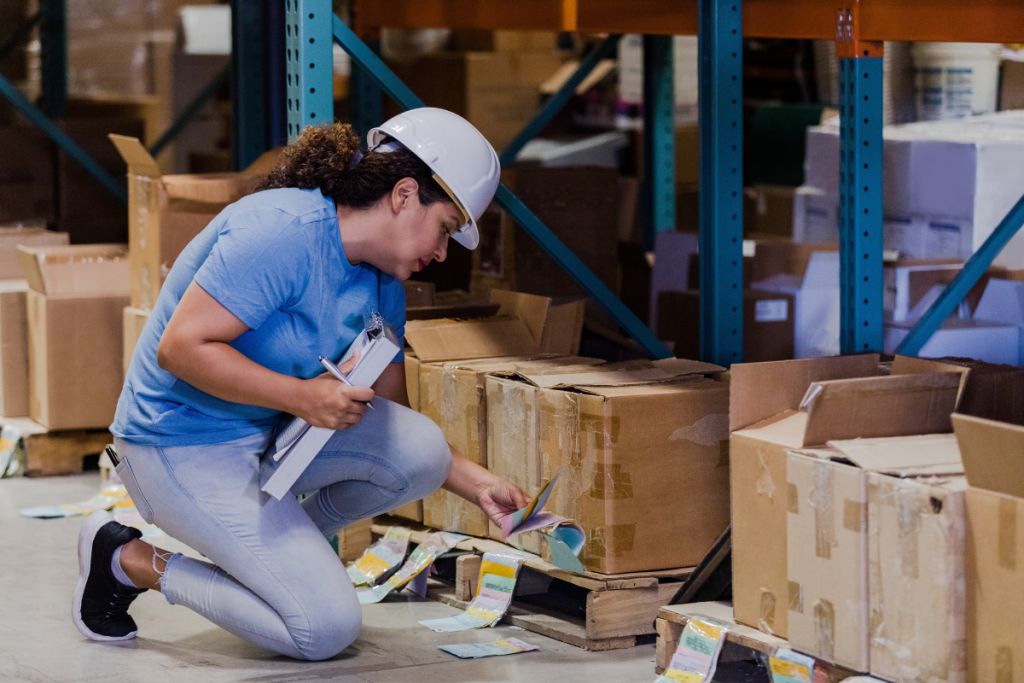
Canada fulfillment refers to third-party logistics (3PL) services that help businesses store inventory, process orders, pack products, and ship them to customers across the country. For eCommerce brands, working with 3PL companies in Canada can mean faster delivery, fewer cross-border shipping challenges, and a more consistent customer experience. The right Canadian fulfillment partner can also make it easier to expand into the market without managing warehouse space, labour, and distribution internally.
Fulfillment services can vary significantly from one provider to another. Some specialize in fast-moving consumer goods, while others are better suited to subscription boxes, oversized products, or more complex inventory requirements. Comparing each provider’s capabilities, technology, warehouse network, and service model can help businesses find the right fit for their operations.
Comparing Fulfillment Costs in Canada
Fulfillment pricing in Canada can vary based on order volume, SKU count, storage requirements, product dimensions, shipping destinations, and the amount of handling involved. A quote that looks inexpensive at first can change once receiving, packaging, returns, special projects, and carrier charges are included. Reviewing how each cost area is billed can give businesses a clearer picture of their expected total fulfillment spend.
| Cost area | Common pricing approach | What can increase costs | What to confirm with your 3PL |
|---|---|---|---|
| Order processing | Per order, shipment, or volume tier | Split shipments, multiple shipping locations, or special order rules | How an order and shipment are defined and when additional handling charges apply |
| Picking | Per item, order line, or additional pick | Orders with multiple SKUs, bundles, kits, or higher unit counts | How the first and additional picks are priced |
| Packaging | Per package, material used, or included within certain fulfillment charges | Branded boxes, inserts, protective materials, or non-standard cartons | Which standard packaging materials are included and how custom packaging is billed |
| Receiving | Per pallet, carton, unit, or labour hour | Mixed-SKU cartons, missing labels, additional sorting, or inaccurate inbound details | Receiving requirements and charges for additional preparation or handling |
| Storage | Per pallet, bin, shelf, or cubic space | Oversized inventory, seasonal increases, and products stored for longer periods | How storage space is measured and how frequently charges are calculated |
| Returns | Per return, item, or handling activity | Inspection, repacking, relabelling, product grading, or disposal | What is included in the standard return process and which activities carry additional charges |
| Special projects | Per unit, project, or labour hour | Kitting, assembly, relabelling, inventory counts, and custom preparation | Labour rates, minimum charges, and approval procedures before additional work begins |
| Shipping | Based on parcel dimensions, weight, destination, and service level | Remote locations, oversized parcels, expedited shipping, and carrier surcharges | How transportation costs and carrier adjustments appear on invoices |
Businesses should compare fulfillment quotes using their actual order and inventory patterns rather than a single advertised rate. Average units per order, monthly shipment volume, storage needs, return activity, and seasonal peaks can all change the final cost. Speed Commerce works with businesses to assess these requirements across warehousing, fulfillment, and distribution so pricing can be evaluated within the context of the operation as a whole.
Latest Canada eCommerce & Logistics News 2025
January
- Walmart Canada has announced a significant investment of approximately C$6.5 billion ($4.51 billion) over the next five years to expand its retail footprint and enhance supply chain capabilities. The plan includes the construction of dozens of new stores, beginning with five supercentres in Ontario and Alberta by 2027, along with the modernisation of distribution centres. Walmart Canada also plans to sell its fleet business to Canada Cartage, allowing the company to simplify logistics operations and focus more closely on its core retail activities.
Reference: “Walmart Canada to Pour Billions into New Stores, Supply Chain Upgrades” (https://www.supplychainbrain.com/articles/41126-walmart-canada-to-pour-billions-into-new-stores-supply-chain-upgrades)
February
- President Donald Trump’s recent imposition of a 25% tariff on Canadian imports has significantly disrupted Canadian eCommerce. The removal of the de minimis exemption, which previously allowed tax-free imports of goods under $800, has led to increased costs and logistical challenges for Canadian online retailers. In response, Canadian consumers and businesses are rallying behind a “Buy Canadian” movement, emphasizing local products to mitigate reliance on U.S. imports.
Reference: “‘Chaotic moment’: How Trump threw a wrench in the gears of Canadian e-commerce” (https://financialpost.com/technology/how-trump-threw-wrench-gears-canadian-e-commerce)
August
- The U.S. raised tariffs on Canadian imports to 35% effective August 1 (USMCA-qualifying goods remain exempt), while Canada Post labor talks stayed unresolved after workers rejected the corporation’s final offers on August 1, keeping a national overtime ban in place. Ottawa also announced up to C$1.2 billion in support for the softwood lumber sector on August 5. Later this month, the U.S. will suspend the de minimis exemption for low-value imports effective August 29, affecting cross-border parcels.
Reference: “Trump increases tariff on Canada to 35% from 25%, cites fentanyl.” (https://www.reuters.com/world/americas/trump-increases-tariff-canada-35-25-cites-fentanyl-2025-07-31/)
Canada Fulfilment and eCommerce Market Statistics and Trends
In 2023, Canada’s eCommerce gross merchandise value (GMV) reached approximately USD 81.7 billion and is projected to grow to USD 118.8 billion by 2028. The competition is led by major players such as Amazon Canada, Walmart, and Shopify. Amazon alone dominates with over 160 million monthly visitors.
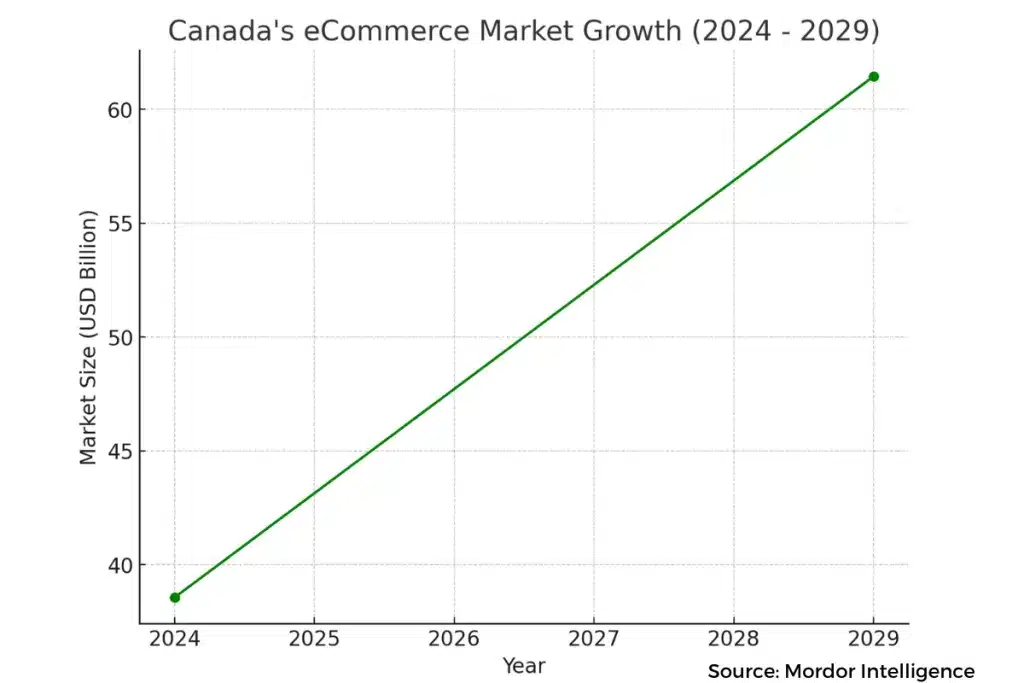
The Canadian eCommerce market is expected to generate around USD 38.56 billion in revenue by 2024, with projections to grow to USD 61.45 billion by 2029. This equates to a compound annual growth rate (CAGR) of 9.77% over the forecast period.
Here are some of the latest trends shaping the Canadian 3PL services scene:
International Trade and Cross-Border Logistics – International trade agreements, such as the United States-Mexico-Canada Agreement (USMCA), have expanded cross-border trade and intensified the need for 3PL providers with expertise in international trade to navigate complex regulatory requirements.
Automation and Artificial Intelligence – Automation and robotics are particularly important in warehousing, where they improve inventory management and order-picking processes. AI-driven predictive analytics also help optimize delivery routes, forecast demand, and improve customer service.
Green Logistics – Sustainability is now a priority, with companies adopting eco-friendly practices such as electric vehicles and optimized shipping routes.
Take Charge of Canada eCommerce
request a quote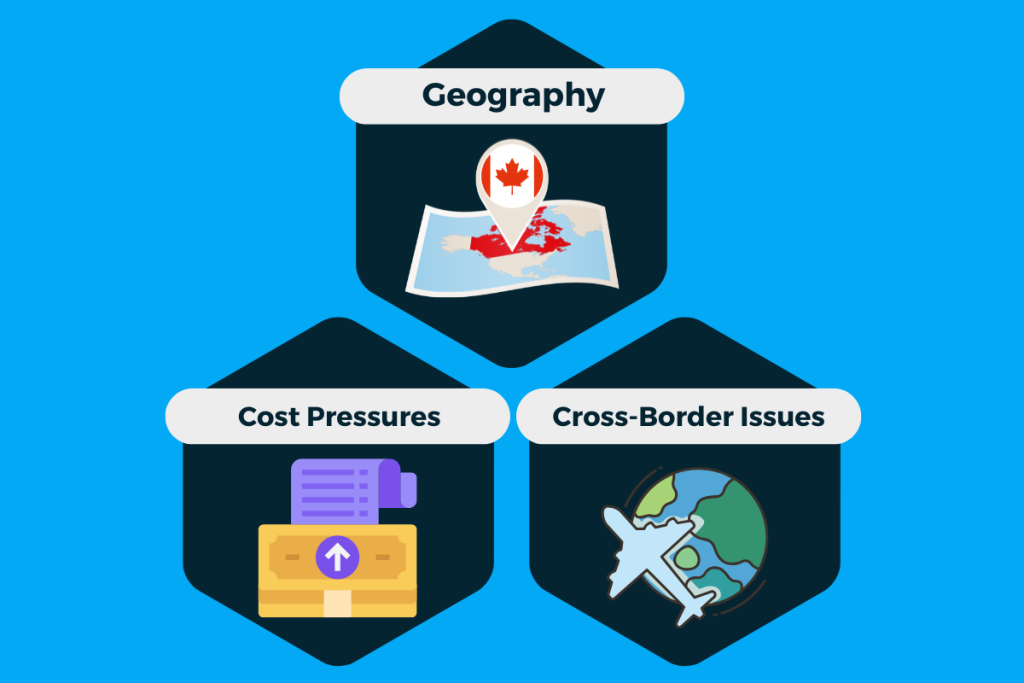
Top 3 Challenges of Canada Fulfillment
Canada’s fulfillment scene presents several challenges, particularly due to its geography, regulatory environment, and growing consumer demands. Here are the fulfillment challenges of Canadian businesses:
Geographical Challenges
Canada’s large landmass and low population density outside of major cities increase last-mile delivery costs, making it difficult to meet expectations for fast shipping. Not to mention, winters in many parts of Canada can be severe, which can cause delays in transportation.
Cross-Border Complexities
Dealing with customs regulations, tariffs, and tax systems like GST and HST can slow shipments and increase costs. In addition, Canada has a multi-layered tax system, including Goods and Services Tax (GST) and Harmonized Sales Tax (HST), which can be challenging to handle.
Cost Pressures
Shipping costs in Canada can be higher than in other countries because major cities are far apart and rural areas have lower population density. International shipping can cost even more due to cross-border fees and long-distance freight charges.
How Can 3PLs Help Canadian Businesses?
3PL services significantly benefit the volatile nature of the Canadian eCommerce market. One of the most significant advantages of 3PLs is that it cuts down logistics costs. Some 3PLs also specialize in Canadian logistics so they can guarantee compliance with Canadian regulations and the latest technological advancements.
Why Businesses Should Invest in Canada Fulfillment Services
Canada’s geography and regulatory environment present significant challenges for businesses, especially those involved in eCommerce and cross-border trade. Fulfillment providers help address these difficulties in many ways.
Below are the benefits of Canadian fulfillment services:
Faster Delivery Times
Logistics companies in Canada often have multiple distribution centers strategically located near major urban areas in Canada, such as Toronto, Vancouver, and Montreal. This allows businesses to store products closer to their customers. Having fulfillment centers spread across different regions also cuts down transit times.
Canadian fulfillment services also invest in route optimization technologies and crowdsourced delivery models to support faster last-mile delivery. These approaches can help shorten delivery windows and improve delivery efficiency.
Cheaper Logistics and Fulfillment Costs
Fulfillment providers often negotiate volume-based discounts with major carriers like Canada Post, UPS, and FedEx. Since they ship large volumes of goods for multiple clients, 3PLs can secure significantly lower shipping rates than individual businesses could obtain on their own. These savings are then passed on to businesses using their services.
Fulfillment providers can also consolidate shipments from different businesses into larger, more efficient loads, reducing the per-unit shipping cost.
| Cost factor | In-house fulfillment | 3PL fulfillment |
|---|---|---|
| Warehouse lease/ownership | High | Flexible |
| Staffing and labor | High | Low |
| Shipping rates | High | Low |
| Technology costs | High | Low |
| Packaging and materials | High | Low |
Efficient Returns Management
Fulfillment providers have dedicated teams and systems in place to manage returns. When customers return products, these fulfillment centers quickly assess, process, and restock the items, reducing delays in re-entering inventory. Many fulfillment services also use automated returns management systems to track the status of returns in real-time.
Simplified Customs and Tax Management
Fulfillment providers, particularly those providing cross-border services, have specialized knowledge of customs regulations and procedures. They guarantee that all documentation is accurate and compliant with Canadian and international customs laws, reducing the risk of delays or fines.
Fulfillment services often partner with customs brokers to facilitate faster processing of goods at international borders. These brokers help clear shipments by managing required tariffs, taxes, and paperwork.
Speed Commerce Fulfillment Services Across Canada
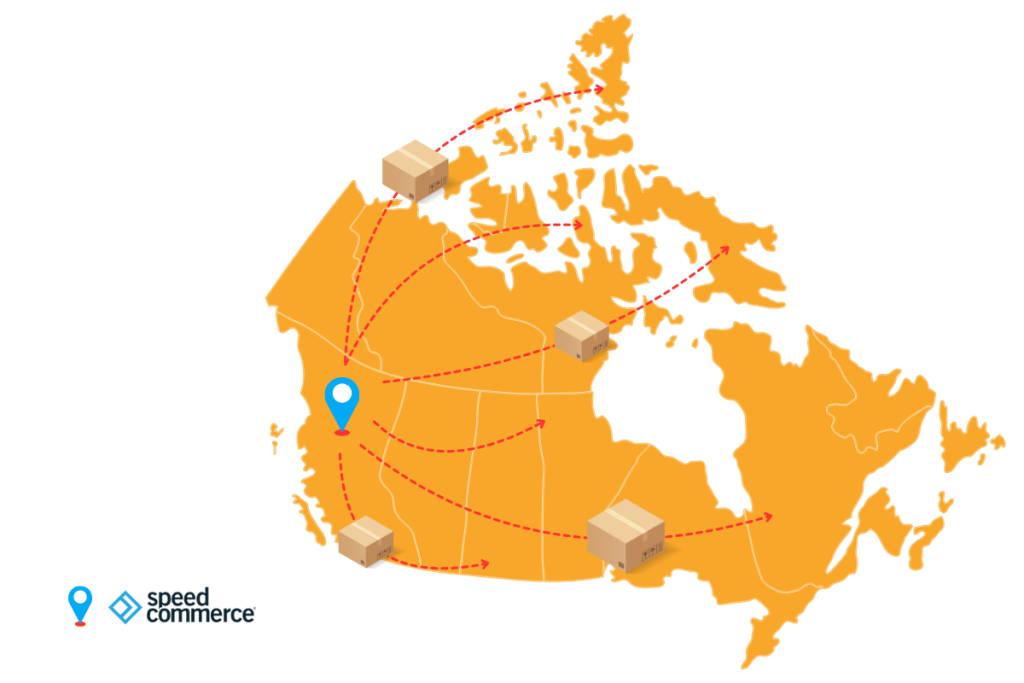
Speed Commerce supports businesses across Canada through our West Coast fulfillment centre in the Vancouver area, with our Canadian head office located in Surrey, British Columbia. From this location, we handle order fulfillment, warehousing, packaging, shipping, returns, kitting, and subscription box fulfillment for eCommerce and direct-to-consumer brands. Our technology also connects with platforms such as Shopify, BigCommerce, WooCommerce, and Amazon, giving businesses better visibility into inventory and orders while supporting distribution across Canada and North America.
Canada Fulfillment Services Done Better
request a quote7 In-Demand Canada 3PL Fulfillment Services
Here are the Canadian 3PL services that businesses should consider investing in:
| 3PL service | Description | Why are they in demand? |
|---|---|---|
| Pick and pack services | Picking individual items from inventory and packing them for shipment to customers. | Simplifies operations and reduces labor costs. |
| Warehousing and inventory management | Storing products in warehouses and managing inventory levels, often using automated systems for real-time tracking and replenishment. | Helps companies manage fluctuating demand. Optimizes stock levels and avoids over/under-stocking. |
| Cross-border fulfillment | Managing the logistics of shipping goods between Canada and international markets, including handling customs and regulatory compliance. | Helps businesses expand into international markets without dealing with the complexities of cross-border logistics. |
| Omnichannel fulfillment | Providing consistent order fulfilment across multiple sales channels, such as online stores, brick-and-mortar locations, and marketplaces. | Gives customers a consistent experience across all platforms. |
| Last-mile delivery | The final step in the delivery process, getting products from a distribution hub to the end customer. | In demand due to rising consumer expectations for same-day or next-day delivery. |
| Returns management | Handling product returns, including inspection, restocking, and processing refunds. | Maintains a positive customer experience. |
| Green logistics | Incorporating environmentally friendly practices into logistics, such as reducing emissions, optimizing packaging, etc. | Growing consumer demand for sustainable business practices makes green logistics increasingly important for companies seeking to reduce their environmental footprint. |
What to Look for in a 3PL Partner
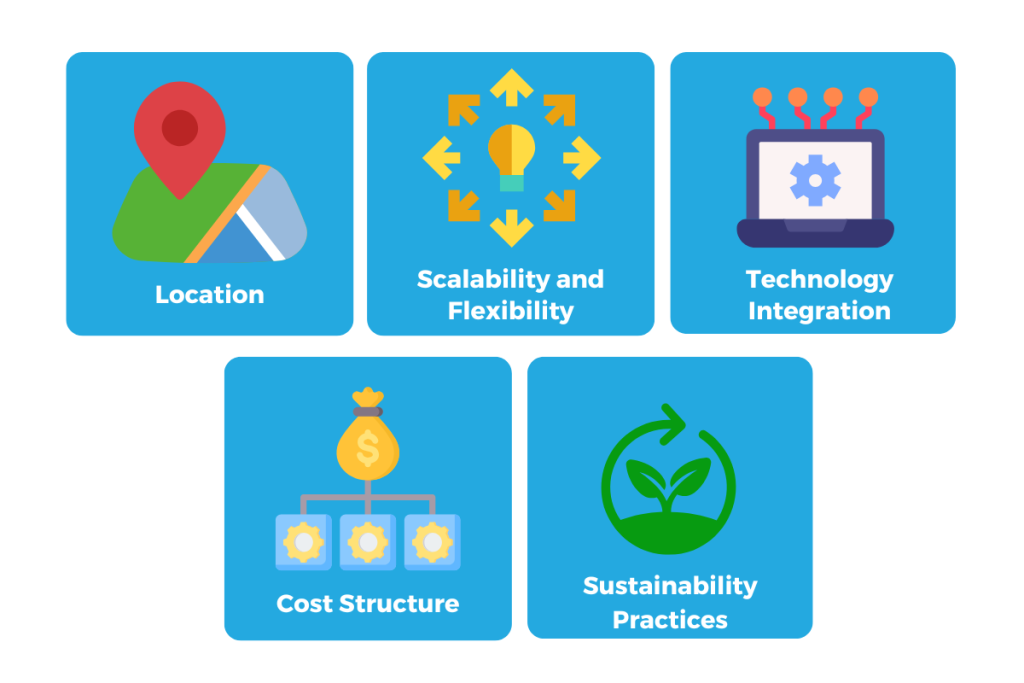
The right logistics company in Canada can significantly impact a business’s performance and growth. Below are the various characteristics that every business should consider when choosing a 3PL partner:
Location of Fulfillment Centers
The closer a fulfillment centre is to a business’s customer base, the lower shipping costs can be.
Fulfillment centres located near major customer and transportation hubs can help businesses serve different regions, such as Eastern and Western Canada, without maintaining separate in-house facilities. For example, facilities near Toronto and Vancouver can shorten shipping distances and help reduce delivery costs across much of the country.
Scalability and Flexibility
As a business grows, its logistics requirements can increase quickly. A 3PL partner with scalable solutions can adjust by adding warehouse space, transportation capacity, and other logistics resources as needed. This helps prevent bottlenecks and gives the business the capacity to keep up with growing customer demand.
Technology Integration
3PLs with integrated technology can provide data analytics that help businesses predict demand.
With real-time visibility, automation, ERP integration, and data-driven decision-making, businesses can keep the inventory they need available at the right time and reduce the risk of stockouts.
Cost Structure
Some 3PL providers may advertise a low initial price while adding extra charges later, such as peak-season surcharges, storage fees, or special handling costs. A clear and transparent pricing structure makes it easier to manage cash flow and plan pricing strategies.
Sustainability Practices
Many countries, including Canada, are introducing stricter environmental regulations.
A 3PL partner that prioritizes sustainability can help your business stay aligned with current regulations while preparing for future environmental standards. Non-compliance with environmental laws can lead to fines, delays, and reputational damage.
Break Through Fulfillment Barriers with Ease
check them outFrequently Asked Questions About Canada Fulfillment Services
Q: How do fulfillment services help businesses save costs?
A: Fulfillment centers help reduce operational costs by pooling resources like warehouse space, labor, and shipping infrastructure among multiple clients. They also negotiate bulk shipping rates with carriers, which lowers the shipping costs for individual businesses.
Q: What types of businesses can benefit from using fulfillment services in Canada?
A: Businesses of all sizes, from small startups to large enterprises, can benefit from using fulfillment services. eCommerce companies in particular gain from these services, as fulfillment providers handle logistics, allowing businesses to focus on product development and customer service. The scalability of fulfillment services is advantageous during peak seasons or for companies experiencing growth.
Q: How do fulfillment centers in Canada handle international shipping?
A: Many Canadian fulfillment centres provide international shipping services through global carrier and logistics networks, helping businesses reach customers across a wide range of countries. These providers can also manage customs documentation, duties, and international shipping requirements to reduce friction as orders cross borders.
Q: What are the typical costs associated with fulfillment services in Canada?
A: Costs can vary based on the size and weight of the items, the services required, and the shipping destination. Fulfillment centres typically charge for warehousing, order picking, packing, and shipping. Additional costs can include custom packaging and value-added services, while some providers use tiered pricing based on order volume.
Q: Can fulfillment services scale with my business as it grows?
A: Yes, fulfillment centers are designed to be scalable. As your business grows, fulfillment providers can accommodate increased inventory and order volumes without requiring significant changes in your internal operations.
Q: How do fulfillment centers handle returns?
A: Fulfillment centers manage the returns process by accepting products back into the warehouse, inspecting them for restocking or disposal, and processing refunds or exchanges. Efficient reverse logistics can help reduce return-related costs while maintaining customer satisfaction.
Scale Your Business with Speed Commerce’s Canada Fulfillment Services
Speed Commerce’s advanced technology gives Canadian businesses better visibility and control over their supply chains. Our flexible warehousing and fulfillment solutions help businesses handle seasonal peaks or plan for growth without the extra costs. This adaptability, combined with a deep understanding of cross-border logistics, makes Speed Commerce a valuable Canada fulfillment partner.

Speed Commerce as Your Trusted Canada Fulfillment Partner
Let’s GoMore Canada Fulfillment Resources From Speed Commerce
Canada Fulfillment
The logistics process of storing, packing, and shipping eCommerce orders within or to Canada.
Third-Party Logistics (3PL)
Outsourcing logistics and supply chain management activities to a provider.
Retail Logistics
The process of managing how products move from suppliers to retailers and finally to customers.
Magento Fulfillment
The process of managing and delivering orders placed through Magento stores.