

Yes, especially in parcel delivery. Shipping prices are far above their early-2020 levels, and recurring rate increases continue to add to the bill. Businesses face higher parcel rates and fees, while consumers pay more to send packages and can encounter those costs again when shopping online.
The U.S. Bureau of Labor Statistics’ price index for couriers and express delivery services was 57.9% higher in August 2026 than in January 2020. Separately, USPS’s published retail price for a Priority Mail Small Flat Rate Box rose from $8.30 in January 2020 to $13.65 in its July 2026 schedule, an increase of 64.5%. Those measures cover different parts of shipping, but both show how far prices have moved. [2,16,18]
The explanation goes past fuel alone. Annual rate increases accumulate, surcharges change, and labor, equipment, facilities, and delivery requirements all affect the bill. Some shipping prices do fall. The evidence does not support a claim that every carrier, freight lane, or customer pays more every year.
What does sticky inflation mean for shipping?
Sticky inflation is described as persistent price growth. A high price level is a separate issue: it reflects increases that have already accumulated. Shipping presents both concerns, with elevated prices and continued increases in some rates.
A lower inflation rate means prices are rising more slowly. It does not mean they have returned to their previous level. U.S. consumer inflation reached 9.1% over the year to June 2022. By September 2026, the annual rate was 3.7%, although that was an increase from August’s 3.4%. The initial surge had eased, but price growth had not disappeared. [1,3]
Consider a service that costs $100, rises 10% one year, and then rises 3% the next. It now costs $113.30. Inflation has slowed sharply, yet the customer still pays 13.3% more than at the start. A price reduction would be needed to undo the earlier increase.
For shipping, two questions matter: how much more does delivery cost than it used to, and how fast is that cost changing now? A business can experience a relatively modest annual increase on top of a much larger cumulative increase. Its customers experience the higher total, regardless of which year contributed most to it.
How much have business shipping prices increased?
The BLS courier and express-delivery index provides a broader measure than one carrier’s annual announcement. It rose from 251.700 in January 2020 to 397.396 in August 2026. Rebased to January 2020 = 100, that is an increase to 157.9. [2]
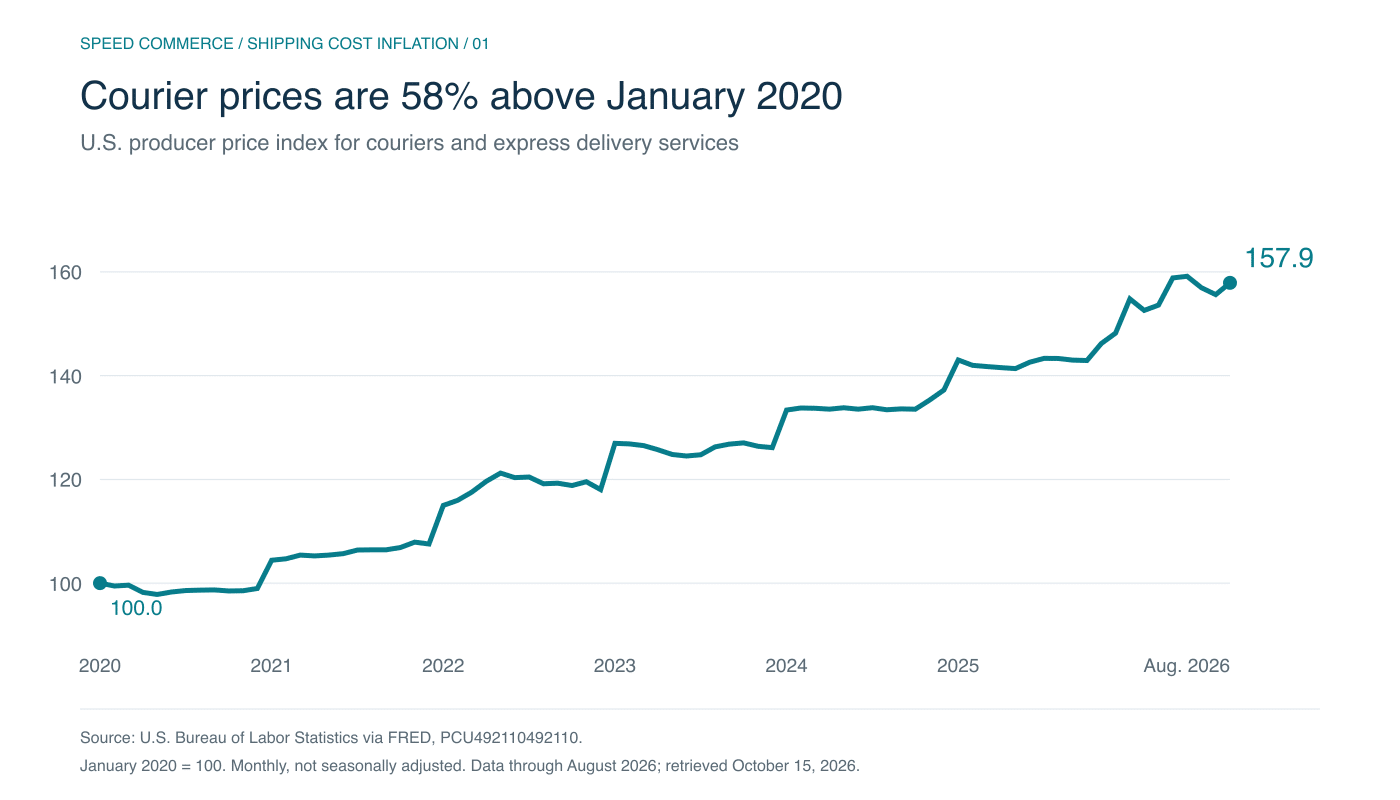
This is an industry price index, not the change in every merchant’s invoice. A merchant’s result also depends on package dimensions, destinations, service levels, discounts, and shipping volume. Changes in those characteristics can move its cost per package even when the underlying rates are unchanged.
FedEx’s announcements illustrate another part of the story: repeated increases to published rates. The table below applies each announced average increase to an illustrative $100 starting amount. It shows compounding, not a historical quote for a particular shipment. [4–10]
| Rate year | Average increase | Illustrative amount |
|---|---|---|
| 2020 baseline | — | $100.00 |
| 2021 | 4.9% | $104.90 |
| 2022 | 5.9% | $111.09 |
| 2023 | 6.9% | $118.75 |
| 2024 | 5.9% | $125.76 |
| 2025 | 5.9% | $133.18 |
| 2026 | 5.9% | $141.04 |
| 2027 announced | 5.9% | $149.36 |
Sources: FedEx announcements and filings. [4–10] Calculation: previous amount × (1 + annual increase), retaining precision before rounding. Applies the headline averages for the covered parcel services; excludes surcharges and negotiated discounts. The 2027 change is announced for January 4, 2027, and is not yet in effect.
The illustrative increase through 2026 is 41.0%. Including the announced 2027 increase brings it to 49.4%. Simply adding the annual percentages would understate the result because each increase applies to a higher starting point.
There is no contradiction between this illustration and the BLS index. One compounds a carrier’s published average announcements. The other measures prices across an industry. Neither should be treated as a substitute for repricing a merchant’s own shipments.
Did shipping costs follow fuel prices back down?
Fuel became cheaper for a substantial period after 2022. EIA data show the U.S. annual average retail diesel price falling from $4.989 per gallon in 2022 to $4.214 in 2023, $3.760 in 2024, and $3.660 in 2025. That was a 26.6% decline from 2022 to 2025. [11]
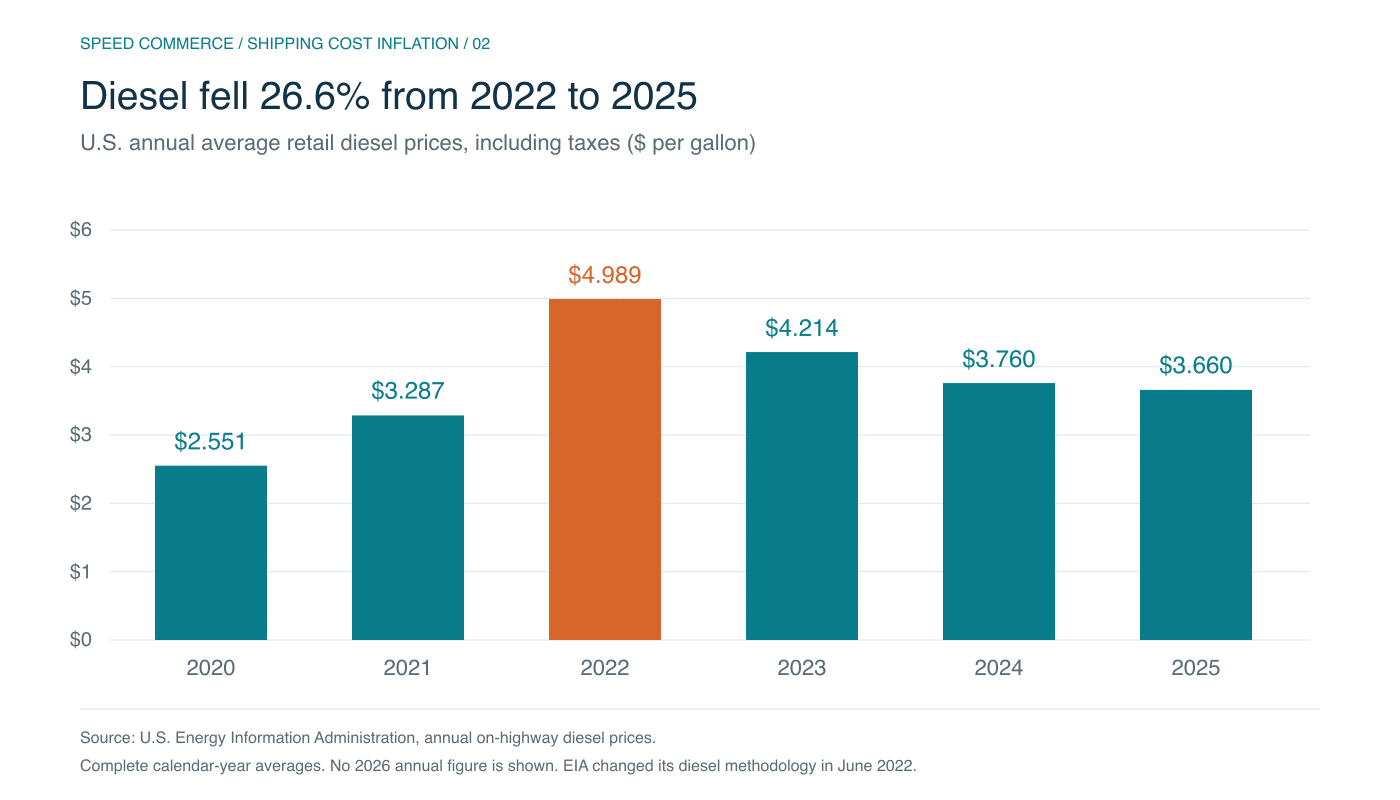
During those three years of falling annual diesel prices, FedEx still implemented average parcel rate increases of 6.9%, 5.9%, and 5.9%. Lower fuel costs did not reverse those published base-rate changes. This comparison demonstrates that the two measures can move in different directions; it does not isolate how much of any customer’s total bill came from fuel. [6–8,11]
The current fuel picture is different. EIA’s weekly national diesel price reached $6.529 on September 21, 2026, before easing to $6.179 on October 12. That is a 5.4% decline over three weeks, but still a high price. Those weekly readings should not be presented as a 2026 annual average. [12]
There is also a distinction between the fuel price and the formula used to calculate a fuel surcharge. In its October 13 analysis, AFS estimated that diesel returning to $2.91 per gallon would still produce a 23.75% fuel surcharge under the newer tables, compared with 7.75% in its Q1 2021 comparison. That is a counterfactual calculation, not a forecast that diesel will return to that price or a universal surcharge for every carrier. [13]
A fuel surcharge can decline from one week to the next while staying above the amount that the same fuel price would have produced years earlier. Businesses need to check both the fuel benchmark and the carrier’s applicable table.
Why can the final shipping bill rise faster than the base rate?
The transportation rate is only one part of a parcel invoice. Residential delivery, delivery-area classifications, additional handling, oversized packages, peak demand, and other charges can change the total. A discount on the transportation component may leave much of that exposure untouched.
Some fees also become part of the amount on which another fee is calculated. FedEx states that fuel surcharges for Ground and Home Delivery apply to the net package rate plus specified applicable surcharges, including residential delivery, delivery-area, and additional-handling charges. [14]
| Invoice component | Earlier example | Later example |
|---|---|---|
| Net transportation charge | $10.00 | $11.00 |
| Fuel-eligible additional charges | $5.00 | $7.00 |
| Illustrative fuel percentage | 10% | 20% |
| Fuel charge on subtotal | $1.50 | $3.60 |
| Total | $16.50 | $21.60 |
Hypothetical arithmetic, not a carrier quote or measured historical shipment. Fuel is calculated on transportation plus the assumed fuel-eligible additional charges. The total rises by $5.10, or 30.9%.
Eligibility changes matter too. A parcel can become more expensive because its destination moves into a different surcharge category, its packaging crosses a handling threshold, or the carrier changes how a fee applies. A business can face a higher bill without changing the number of orders it ships.
FedEx’s announced 2027 changes include revised delivery-area and pickup-area ZIP-code lists, as well as surcharge changes. The 5.9% headline average is therefore a starting point for budgeting, not a cap on an individual shipper’s increase. [10]
Are carriers’ own costs still rising?
Yes, and that matters when explaining persistent shipping prices. The American Transportation Research Institute’s July 2026 report put the average cost of operating a truck in 2025 at $2.336 per mile, up 3.4% from 2024. Excluding fuel, costs rose 4.2% to $1.854 per mile. Tolls, repairs and maintenance, driver benefits, and tires were among the largest percentage increases. [15]
These are trucking operating-cost benchmarks, not a breakdown of a UPS or FedEx parcel invoice. They still demonstrate why a fuel decline cannot be expected to reduce every transportation cost by the same percentage. A truck must be purchased, maintained, staffed, and insured whether diesel is rising or falling.
Warehouse conditions add another layer. The September 2026 Logistics Managers’ Index recorded warehousing prices at 73.5 and warehousing capacity at 39.3. In that survey, readings above 50 indicate expansion and below 50 indicate contraction. The figures describe the direction and breadth of change; they do not mean warehouse prices rose 73.5% or that 39.3% of space was available. [19]
For an ecommerce business, storage, receiving, picking, packing, and parcel transportation are separate cost lines. Moving inventory closer to customers may reduce outbound shipping while increasing storage or replenishment costs. A useful cost review follows the full order through the operation instead of optimizing a single line in isolation.
Where do consumers see shipping inflation?
Consumers see it directly when they mail a package. USPS’s archived retail schedules provide concrete comparisons for familiar domestic Priority Mail Flat Rate products. The dates matter: these are prices listed in the January 2020, January 2026, and July 2026 schedules, rather than annual averages. [16–18]
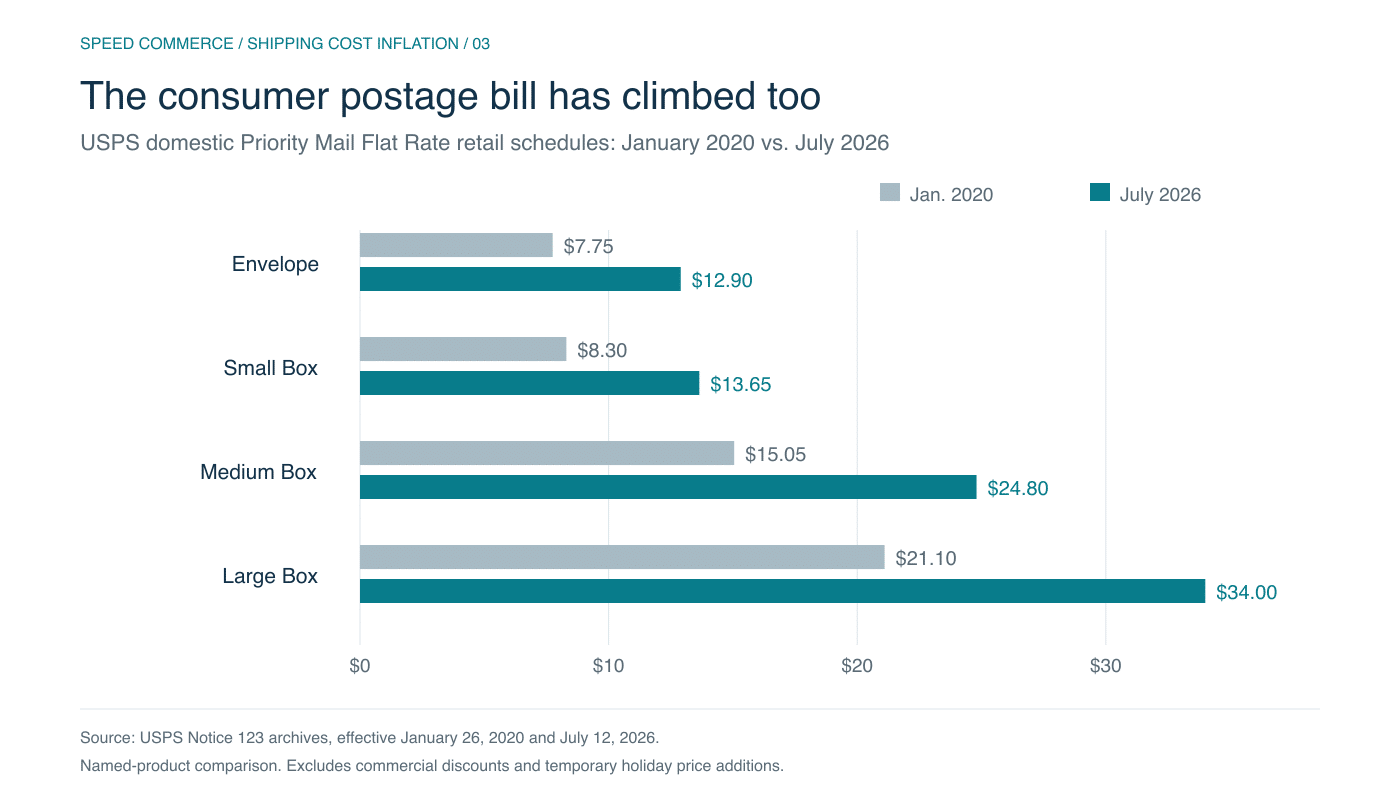
| Priority Mail product | Jan. 2020 | Jan. 2026 | July 2026 | 2020–July 2026 |
|---|---|---|---|---|
| Flat Rate Envelope | $7.75 | $11.95 | $12.90 | +66.5% |
| Small Flat Rate Box | $8.30 | $12.65 | $13.65 | +64.5% |
| Medium Flat Rate Box | $15.05 | $22.95 | $24.80 | +64.8% |
| Large Flat Rate Box | $21.10 | $31.50 | $34.00 | +61.1% |
Retail published rates, not negotiated business prices. Sources: USPS Notice 123, effective January 26, 2020; January 18, 2026; and July 12, 2026. [16–18] Percentage change = (July 2026 price ÷ January 2020 price − 1) × 100.
Seasonal pricing can add to that higher base. USPS’s 2026 holiday announcement specifies a $1.00 retail increase for most Priority Mail Flat Rate products and $2.10 for Large Flat Rate Boxes for the October 4–January 17 window. Those temporary additions are excluded from the comparison above. [20]
Online shoppers can experience shipping costs less visibly. A retailer may absorb the increase in its margin, charge more for delivery, adjust product prices, raise the order value needed for free shipping, or reduce the delivery options included at no extra charge. These are possible business responses, not evidence that every retailer has made each change.
A free-shipping label does not eliminate the delivery expense. It changes who pays it directly and how the retailer recovers it. For consumers, the useful comparison is the total amount paid for the goods and delivery, together with the promised arrival date and any return charges.
There is a limit to how easily merchants can pass on the increase. In Baymard’s 2026 checkout-abandonment research, after setting aside the just-browsing segment, 40% cited extra costs such as shipping, taxes, and fees, while 20% cited slow delivery. The 40% figure covers several costs together; it is not the percentage of all carts lost because of shipping alone. [21]
Does every shipping market show the same pattern?
No. Shipping includes parcel networks, full truckloads, less-than-truckload freight, ocean containers, and air cargo. Their prices respond to different capacity constraints, contracts, and demand patterns. A lower ocean rate does not automatically produce a lower domestic parcel rate.
Drewry’s World Container Index fell 2% in the week to October 8, 2026, to $4,351 per 40-foot container. That composite spot-rate measure is a different product from a domestic parcel service. It nevertheless provides a current example of shipping prices moving down. [22]
The courier index also has downward months. Its persistence above the 2020 level should not be confused with a perfectly uninterrupted rise. Discount negotiations, a different service mix, more efficient packaging, or a better-matched carrier can also improve an individual merchant’s result.
Looking ahead, the October TD Cowen/AFS report projects its ground-parcel rate-per-package index at 43.3% above the January 2018 baseline in Q4 2026, up 5.8% year over year. That is a forecast from a separate dataset, not an already observed BLS result or a prediction for every account. [13]
Will shipping costs return to their old levels?
The current evidence gives businesses little reason to budget around a broad return to 2020 parcel prices. The industry index is much higher, repeated rate increases have accumulated, and FedEx has announced another increase for 2027. Fuel relief can help, but it does not automatically undo the other components of a delivery bill.
That still leaves room to reduce the cost of fulfilling an order. The practical task is to identify which parts of the bill reflect market prices and which reflect packaging, service selection, inventory placement, or avoidable operational work.
Speed Commerce works with ecommerce businesses on warehousing, inventory management, pick and pack, and order fulfillment. A fulfillment review can examine those decisions together, using the merchant’s actual order profile to identify where changes may improve cost and delivery performance.
Data and calculation notes
All figures are nominal U.S. measures unless stated otherwise. The research cutoff is October 15, 2026, before that day’s scheduled U.S. PPI release; the courier series therefore ends in August 2026. CPI rates describe year-over-year changes, while the courier chart shows a cumulative price level. FedEx compounding is an illustration using announced average increases. USPS comparisons use dated retail schedules. EIA annual and weekly figures are kept separate. Forecasts, announced future changes, and hypothetical examples are labeled where they appear. Percentages are calculated from unrounded inputs and rounded to one decimal place.
References
- U.S. Bureau of Labor Statistics. Consumer Price Index — September 2026. October 14, 2026.
- U.S. Bureau of Labor Statistics via FRED. Producer Price Index by Industry: Couriers and Express Delivery Services, PCU492110492110. Data through August 2026; retrieved October 15, 2026.
- U.S. Bureau of Labor Statistics. Consumer Price Index — June 2022. July 13, 2022.
- FedEx. Shipping Rates to Increase for FedEx Express, FedEx Ground and FedEx Freight Services. September 14, 2020.
- FedEx. Shipping Rates to Increase for FedEx Express, FedEx Ground, and FedEx Freight Services. September 20, 2021.
- FedEx / U.S. Securities and Exchange Commission. FedEx first-quarter results, Exhibit 99.1 — 2023 Rate Increases. September 22, 2022.
- FedEx. FedEx Announces Adjusted Shipping Rates, Fees, and Surcharges. August 29, 2023.
- FedEx / U.S. Securities and Exchange Commission. FedEx 2025 Form 10-K — Pricing. Fiscal year ended May 31, 2025.
- FedEx. FedEx Reports First Quarter Earnings Growth Year-Over-Year — 2026 Rate Increases. September 2025.
- FedEx. Shipping Rate Changes. Updated September 18, 2026; retrieved October 15, 2026.
- U.S. Energy Information Administration. Retail Prices for Diesel (On-Highway) — All Types, Annual. Retrieved October 15, 2026.
- U.S. Energy Information Administration. Retail Prices for Diesel (On-Highway) — All Types, Weekly. October 14, 2026 release.
- AFS Logistics / TD Cowen. Study: High fuel costs, shipping capacity constraints to drive pricey holiday peak season. October 13, 2026.
- FedEx. Weekly Fuel Surcharge Changes. Retrieved October 15, 2026.
- American Transportation Research Institute. New ATRI Report Details Accelerating Costs and Low Profitability Despite Cuts. July 15, 2026.
- U.S. Postal Service. Notice 123 — Price List. Effective January 26, 2020.
- U.S. Postal Service. Notice 123 — Price List. Effective January 18, 2026.
- U.S. Postal Service. Notice 123 — Price List. Effective July 12, 2026.
- Logistics Managers’ Index. September 2026 Logistics Managers’ Index Report. October 6, 2026.
- U.S. Postal Service. U.S. Postal Service Announces Temporary Price Change for 2026 Holiday Shipping Season. August 25, 2026.
- Baymard Institute. 50 Cart Abandonment Rate Statistics 2026. Retrieved October 15, 2026.
- Drewry. World Container Index — 8 October 2026. October 8, 2026.