

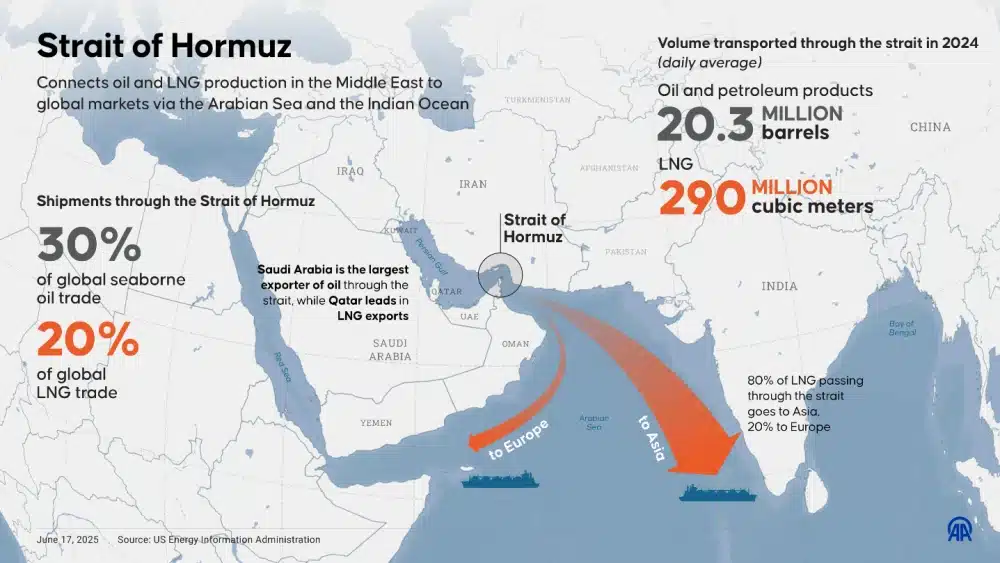
Roughly 20 million barrels per day of crude oil, condensate, and refined petroleum products passed through the strait in 2024 and 2025. This volume accounts for about one-fifth of all seaborne oil trade worldwide. Most of the crude heads to buyers in Asia, with China receiving the largest share. The route also carries significant volumes of liquefied natural gas from Qatar and the United Arab Emirates. But how Much US goes through the strait? Much less than you’d think.
Who are we? Speed Commerce is an end-to-end provider of outsourced customer experience solutions for eCommerce retailers (including for BigCommerce & more) as well as manufacturers, for close to 20 years. We grow our clients’ businesses by providing winning customer experience strategies such as 24/7/365 eCommerce customer service, order fulfillment, and warehousing – get a free quote from a fulfillment expert. Refer to our guide on crowdfunding fulfillment, and east coast fulfillment updated for 2026.
How much oil from the Persion Gulf heads to the United States?
The United States receives a small portion. In 2024, the country imported around 0.5 million barrels per day of crude oil and condensate from Persian Gulf nations through the strait. This figure equals about 7% of total US crude imports and 2% of overall US petroleum liquids consumption.
The overwhelming majority heads to Asia. China alone absorbs 37.7% of all crude transiting the strait. India takes 14.7%. South Korea gets 12%. Japan gets 10.9%. Combined, Asian economies receive more than 80% of the oil moving through the waterway.
The US imported approximately 490,000 barrels per day from Persian Gulf countries in 2025. That sounds like a lot until you consider total US crude imports ran about 6.2 million barrels per day. Persian Gulf oil made up roughly 8% of the total.
Meanwhile, Canada supplied more than 63% of US crude imports. Add Mexico, and North American sources accounted for about 70%.
How has US reliance on Hormuz oil changed?
US imports from the Persian Gulf have fallen steadily over the past decade. Domestic shale production now supplies the majority of American needs. Canada and Mexico provide the bulk of remaining imports. As a result, dependence on oil transiting the Strait of Hormuz sits at some of the lowest levels in four decades.
If the US barely uses the strait, why are gas prices up well over a dollar?
This is the question that trips people up, and it tripped up the White House too. President Trump said in early March that the Hormuz disruption “doesn’t really affect” the US the way it does other countries. Energy Secretary Chris Wright on Fox News reminded viewers that the US produces more oil than it consumes.
Both statements contain a grain of truth wrapped in a lot of missing context.
Regionally sourced, globally priced
Oil is traded on a global market. When 20% of the world’s seaborne supply disappears from that market, the price goes up everywhere, for everyone, regardless of where you source your barrels.
Mark Finley, a fellow in energy and global oil at Rice University’s Baker Institute, summed it up: when something goes wrong anywhere in the global oil market, the price goes up everywhere.
West Texas Intermediate crude, the US benchmark, jumped about 41% in the first two weeks of the conflict. Brent crude, the international benchmark, surged above $126 per barrel at its peak. Gas prices at the pump rose more than $1 per gallon nationally, and parts of California crossed $5.
What if the strait reopens, but not for U.S. or Israeli-linked shipping?
Reuters reports on April 3 that Iran said it would permit passage for ships with no U.S. or Israeli links, and that Omani, French, and Japanese vessels had crossed the strait under that policy. Reuters also reported on April 4 that Iran had authorised passage for ships carrying goods to Iranian ports, and on April 5 and 6 that the strait was still largely shut, even as a handful of exempted ships got through and Iraq moved toward restarting some export nominations.
That doesn’t automatically mean US-bound cargoes would drop to zero. It does suggest a messier market with fewer eligible ships, pricier insurance, more hesitation from owners and charterers, and tougher competition for non-restricted cargo space. The reading is an inference from the current traffic rules and freight conditions, not a settled rulebook, but it fits what EIA and Reuters are describing. EIA said tanker rates for VLCCs from the Middle East to Asia in March 2026 hit their highest level since at least November 2005, helped by physical risk in the strait, war-risk insurance costs, and a backlog of trapped vessels.
How does this situation affect ecommerce supply chains?
Higher oil prices translate directly into elevated freight rates and fuel surcharges. Carriers add war risk premiums on top of standard shipping fees. Many ecommerce sellers face increased costs for both inbound inventory and outbound deliveries.
Petrochemical products derived from oil also influence packaging and plastic component prices. Longer transit times from rerouted vessels add pressure to just in time fulfillment models.