
Dimensional Weight Calculator & Guide: UPS, Fedex, USPS
DIM Weight Calculator for 2026
Fill in the actual weight, length, width and height.
UPS, USPS, Fedex Dimensional Weight Calculator
Estimate DIM weight, billed weight, package metrics, with an international shipping option, updated for 2026.
Your Package Information
DIM Weight & Billed Weight

UPS

FedEx

USPS
Package Metrics
Calculator uses published domestic parcel rules current as of March 2026 and is for demo purposes only.
What Is Dimensional Weight in Shipping?
Dimensional weight, often shortened to DIM weight, is a pricing method that looks at how much space a package takes up, not just how much it weighs on a scale. Carriers compare the package’s actual weight with its dimensional weight, then charge based on the higher number.
This matters most when a parcel is large but light. A bulky carton filled with low-density items can cost more to ship than a smaller, heavier carton because it takes up more room in a truck or aircraft.
Why Do Carriers Use Dimensional Weight?
Carriers use dimensional weight to price space more accurately. A truck or plane can run out of room before it runs out of weight capacity, so package size affects shipping cost in a real way. FedEx and DHL both explain DIM or volumetric weight as a way to account for how much room a shipment uses compared with its actual weight.
For shippers, that means packaging choices matter. Two cartons can weigh the same, yet the larger one can still cost more if its cube is much bigger.
The Calculator Explained: How to Calculate Dimensional Weight
Calculating DIM weight is straightforward:
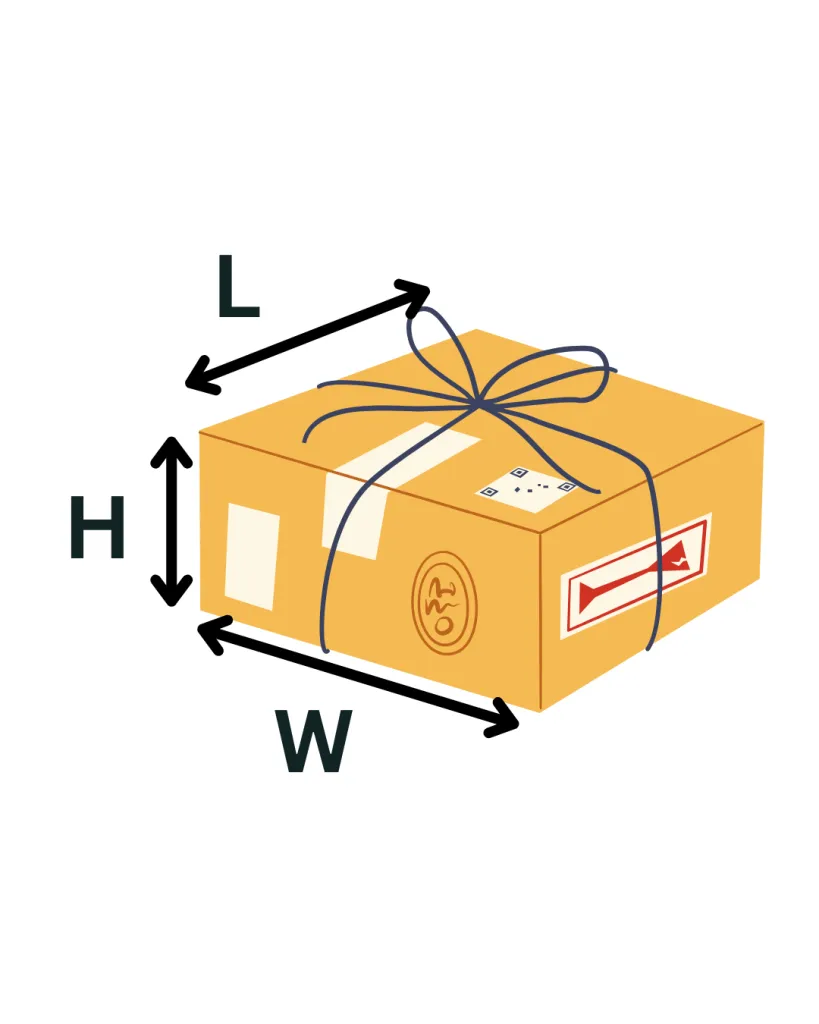
- Measure the Package – Record the length, width, and height of the package in inches.
- Calculate the Volume – Multiply these dimensions to get the cubic size.
- Apply the DIM Divisor – Divide the cubic size by a standard number called the DIM divisor, which varies by carrier.
For example, if your package measures 18 inches on all sides, the calculation would be:
18 (L) x 18 (W) x 18 (H) = 5,832 cubic inches
If the carrier’s DIM divisor is 139:
5,832 ÷ 139 ≈ 41.96 pounds
In this case, the dimensional weight is approximately 42 pounds. The carrier will charge based on either this DIM weight or the actual weight, whichever is higher.
Carrier-Specific DIM Divisors
Different carriers use different DIM divisors:
- FedEx and UPS – Typically use a divisor of 139 for both domestic and international shipments.
- USPS – Uses a divisor of 166 for packages exceeding one cubic foot (1,728 cubic inches).
- DHL – Generally applies a divisor of 139 for international shipments.
It’s always a good idea to check with your specific carrier, as these numbers can change.
DIM Weight Thresholds vary by carrier. USPS only applies dimensional weight to packages larger than 1 cubic foot (1,728 cubic inches). FedEx and UPS always use dimensional weight with no minimum size threshold.

Why Use Our Calculator Over The Others?
Multi-Carrier Comparison
Unlike single-carrier calculators, we support all major services with their exact 2024–2025 DIM divisors.
Real Cost Prevention
“Last month, a customer saved $78 by adjusting their box size using these calculations.”
Global Ready
Automatically converts metric measurements for international shipments.
Always Updated
We track annual changes to carrier rules so you don’t have to.
How to Use This Calculator: Step by Step Process, From Getting Your Billable Weight to Figuring Out Your Shipping Cost
For a step by step rundown of the process that takes you from using the calculator to getting a shipping cost, see the below. If you just want to get DIM and billable weights you can go straight to the calculator above. Our Dimensional Weight Calculator simplifies this process by helping you determine the billable weight of your package, which carriers use to calculate shipping fees, but its only half the process. Here’s the full rundown:
Interactive Process Chart
Click a card to view more tips during each step.
Guide
How to Use This Calculator
Click a step to learn more
Dimensions
Dimensions
Weight
Carrier
DIM
Weight
Rate Tool
Details
Rates
Compare Carrier Shipping Rates Using DIM Weights
Below is a comparison between four major carriers.
INTERACTIVE CARRIER COMPARISON TABLE
Select a carrier below to view its dimensional weight formula and billing rules




DIM Divisor
139
inches & pounds — U.S. domestic
Billable Weight Rule
The greater of actual weight and dimensional weight is used as the billable weight for all package shipments.
Greater of actual vs. DIMFormula
UPS U.S. daily rate materials state that shippers divide cubic size in inches by 139 to determine dimensional weight for package shipments. Billable weight is the greater of actual weight and dimensional weight.
DIM Divisor
139
U.S., Puerto Rico & international
Billable Weight Rule
Shipments are charged on dimensional weight or actual weight, whichever is greater. DIM weight is based on package size relative to actual weight.
Greater of actual vs. DIMFormula
FedEx’s published formula uses 139 for U.S., Puerto Rico, and international shipments. DIM weight applies based on package size relative to actual weight — whichever is greater becomes the billable weight.
DIM Divisor
166
rectangular parcels exceeding 1,728 in³
Applies To
Priority Mail parcels going to Zones 1 through 9 that exceed 1 cubic foot (1,728 cubic inches). DIM pricing does not apply below this threshold.
Threshold: > 1,728 in³Rectangular Parcels
Result rounded up to nearest pound
Nonrectangular Parcels
0.785 adjustment factor applied first
Imperial Divisor
139
inches & pounds
Metric Divisor
5,000
centimeters & kilograms
Billable Weight Rule & Formula
The higher of actual weight or volumetric weight is used to calculate shipment cost.
DHL’s standard published divisor is 5,000 for centimeters and kilograms, or 139 for inches and pounds. The higher of actual weight or volumetric weight determines the billable rate.
Carrier Cheat Sheet
| Carrier | Best For | Avoid When |
|---|---|---|
| USPS | Small dense packages | Large lightweight items |
| FedEx | Time-sensitive shipments | International budget shipping |
| DHL | Overseas deliveries | Domestic US packages |
How To Cut DIM Charges
You do not need to cut corners on packaging to reduce DIM weight. The better move is to pack tighter and pack smarter.
Start with the box itself. If the carton is much bigger than the item, the shipment is more likely to bill at DIM weight. Review your most-used cartons first, then look at orders that ship light but still get expensive labels.
Right-size boxes by SKU or order type
Test poly mailers where product protection still makes sense
Review inserts and void fill
Build a carton library for common order combinations
Recheck DIM-heavy orders across more than one carrier
If DIM charges keep showing up across a big share of parcel volume, that usually points to a packaging or fulfillment workflow issue, not just a carrier issue.
Avoid These Mistakes That Raise Billed Weight
A lot of DIM surprises come from simple packing issues. These are the ones to watch:
- Measuring the product instead of the packed carton
- Using a box with too much empty space
- Forgetting that filler, inserts, and retail packaging change the final size
- Assuming USPS uses DIM pricing on every parcel
- Using one carrier’s rule for every shipment
- Skipping package reviews as SKU mix changes
USPS, for example, does not apply its Priority Mail DIM method to every parcel. It applies once the parcel exceeds one cubic foot and is addressed to Zones 1 through 9.
Carriers charge based on the longest side on each dimension. Rotate packages to minimize the largest measurement and reduce your DIM weight.

Frequently Asked Question About DIM Weight Calculator
Actual weight is what the package weighs on a scale. Dimensional weight is a calculated weight based on the package’s size. Carriers usually charge the higher of the two.
Multiply length, width, and height, then divide by the carrier’s DIM divisor. After that, compare the DIM result with the actual weight. The higher number is usually the billed weight.
UPS U.S. daily rate materials show a divisor of 139 for package calculations in inches. Rate type and service details can affect how a shipment is rated, so it is smart to verify the current UPS rule before rating live shipments.
FedEx states that the formula uses 139 for U.S., Puerto Rico, and international shipments measured in inches. FedEx also notes that charges are based on DIM weight or actual weight, whichever is greater.
USPS Priority Mail uses DIM pricing for parcels going to Zones 1 through 9 that exceed 1 cubic foot. For rectangular parcels, USPS divides cubic inches by 166 and rounds up.
Yes. DHL says shipment cost can be based on volumetric or dimensional weight when that number is higher than actual weight. DHL’s standard published divisor is 5000 for cm and kg, or 139 for inches and pounds.
Measure the final packed box. Carriers rate the shipment based on the parcel that actually moves through the network, not the product sitting on its own.
Not always. If the shipment is bulky for its weight, DIM pricing may still apply. What you can do is reduce unnecessary empty space and use a better-fit package.
In most parcel shipping discussions, yes. Different carriers use different labels, but both terms refer to a size-based weight calculation.
Because the large box takes up more cube in the carrier network. Even if it weighs less, it still uses valuable trailer or aircraft space. That is the problem dimensional weight pricing is built to address.
What Is Dimensional Weight? FedEx. https://www.fedex.com/en-us/shipping/packaging/what-is-dimensional-weight.html. Accessed March 18, 2026.
What Is Dimensional (Dim) Weight and How Do I Calculate It Correctly? FedEx. https://www.fedex.com/en-us/customer-support/faqs/business/shipping/how-do-i-calculate-dim-weight.html. Accessed March 18, 2026.
US 48, Alaska & Hawaii Daily Rates. UPS Rate and Service Guide. UPS. https://www.ups.com/assets/resources/webcontent/en_US/daily_rates.pdf. Published March 31, 2025. Accessed March 18, 2026.
DMM 223 Priority Mail Prices and Eligibility for Commercial Parcels. USPS Postal Explorer. https://pe.usps.com/cpim/ftp/manuals/dmm300/223.pdf. Accessed March 18, 2026.
About Weight. DHL. https://dct.dhl.com/help. Accessed March 18, 2026.
Speed Commerce Resources
Fulfillment Guides Worth Reading
Operations, shipping, and supply chain. Explained for growing brands.

eCommerce Fulfillment
eCommerce fulfillment is the end-to-end process of receiving inventory, picking and packing orders, shipping them, and handling returns.

Pick and Pack Fulfillment Services
As order volume grows, pick and pack gets harder to manage without clear warehouse rules. The right workflow improves speed, accuracy, and packing consistency.

Crowdfunding Fulfillment
From backer surveys to customs and replacements, crowdfunding fulfillment has its own rules. Learn what usually goes wrong and how to plan ahead.

Freight Shipping Quotes
Small freight details can create big pricing swings. See what quotes include, why re-rates happen, and how to estimate costs more accurately before you book.

What Is a Backorder?
When inventory runs out, your next move matters. We explain backorder vs. out of stock, the pros and risks of accepting backorders, and how brands protect sales.

OTIF (On Time, In Full)
One of the most important supply chain metrics for fulfillment reliability. Explore how it works, what causes misses, and how teams improve scores over time.

East Coast 3PL Services
An East Coast 3PL helps brands ship closer to customers across the Northeast, Mid-Atlantic, and Southeast for faster fulfillment and smarter inventory placement.