Best Shopify 3PLs: Top Partners for Shopify Order Fulfillment
Your Shopify store is growing. That’s great news! But it also means you might be drowning in packing tape, shipping labels, and cardboard boxes.
What started as a passion project is now a full-time shipping operation running out of your garage. This is a good problem to have, but it’s a problem.
You need a partner. You need a third-party logistics (3PL) company to manage your eCommerce order fulfillment.
A 3PL handles all the physical stuff: storing your products, picking and packing orders, and shipping them to your customers. This frees you up to do what you do best: grow your brand and make more sales.
But with so many options, how do you choose? We’re here to help. This guide will break down the best Shopify 3PLs. We’ll focus on partners with a seamless Shopify 3PL integration that works perfectly with your store.
Looking for a better fulfillment solution?
A fulfillment expert will get back to you within 1-2 business days.
7 Signs You Need a 3PL for Shopify
Wondering if it’s the right time? If any of these sound familiar, it’s time to start looking.
You might need a 3PL if you spend more time packing than marketing, or if you are simply out of space in your garage or spare room. As you get busier, you might notice more order errors, like shipping the wrong size. This is a sign you need a professional partner whose job is to be 99.9% accurate.
Perhaps you can’t compete with 2-day shipping, or you want to expand internationally but the logistics are a headache. A 3PL solves this by using their warehouse network to get products closer to your customers. They also get huge shipping discounts, which can lower your costs. Above all, if you are completely burned out, handing off fulfillment is the single biggest way to get your time back.
How to Choose the Right 3PL for Your Store
Before you look at the list, you need to know your own needs. The “best” 3PL for a furniture store is the “worst” 3PL for a makeup brand.
Here is your checklist for picking a partner.
Shopify Integration This is non-negotiable. The 3PL must have a deep, seamless integration with Shopify. You want an app or connection that automatically syncs orders, inventory levels, and tracking numbers in real-time. Look for Shopify Plus partners if you are a high-volume brand.
Warehouse Network Where are your customers? If 80% of your sales are in California, you don’t want a 3PL that only has a warehouse in New Jersey. Look for a 3PL with multiple warehouse locations. This lets you offer 2-day shipping to most of the country affordably.
Pricing and Fees 3PL pricing can be confusing. Be direct and ask for a full list of all fees. This includes costs for receiving, storage, pick & pack, shipping, and any monthly account fees. Ask for simple, all-in-one pricing if you can. Avoid partners with lots of hidden fees.
Your Product Type This is critical. Does the 3PL have experience with your products? Items that are heavy, fragile, or high-value need special handling. Likewise, subscription boxes require kitting skills, and food or supplements require FDA-approved, climate-controlled facilities.
Order Minimums Some 3PLs are built for giants. They will not work with you unless you ship 1,000 orders a month. Others are built for startups and have no minimums at all. Find one that fits your current size but has the room for you to grow.
Customer Support When a big order goes wrong, who do you call? Can you get a real person on the phone? Or are you stuck with a chatbot? Look for a 3PL that gives you a dedicated account manager or a support team you can actually reach.
Top 3PL Providers Compared
A side-by-side look at the leading third-party logistics and fulfillment providers, what each is best suited for, and their order minimums.
| 3PL Provider | Best For | Key Features | Order Minimums |
|---|---|---|---|
| Speed Commerce | All-in-One Customer Experience | Shopify Plus Partner, 24/7 Customer Service, Personalization (Engraving), Flat-Rate Pricing | Scalable |
| ShipBob | International & Fast Scaling | Shopify Plus Certified App, 50+ Global Warehouses, 2-Day Shipping, Omnichannel | Varies (Best for 200+/mo) |
| ShipMonk | Startups & Subscription Boxes | Native App, “Stress-Less” Platform, Strong Kitting | No |
| eFulfillment Service | Small Businesses (Value) | Native App, No Setup Fees, High-Touch Support, Simple Pricing | No |
| Shopify (SFN) | Shopify-First Brands | Built-in (Native), “Shop Promise” Badge, Managed in Shopify Admin | Yes (Varies) |
| Amazon MCF | Amazon FBA Sellers | App Integrations, Uses Amazon’s Network, Fast 1-2 Day Shipping | No |
| ShipHero | Tech-Focused Brands | Native App, 3PL Service or standalone WMS Software, 99.9% Accuracy Claim | Varies |
Choose the Best Shopify 3PL
The Best 3PLs for Shopify Stores (Our Top 7 Picks)
Here are the top players in the Shopify 3PL space, broken down by what they do best.
1. Speed Commerce – Best Overall Shopify 3PL and Custom Packaging
Speed Commerce works well for Shopify brands that need more than basic pick-and-pack fulfillment. Shopify orders can move into the warehouse alongside marketplace and wholesale orders, while inventory, shipping, returns, kitting, and customer care remain connected.
The company also handles branded boxes, inserts, product bundles, relabeling, and other packing instructions. No annual contracts or minimum order caps make the model accessible to growing stores without limiting larger accounts. Speed Commerce earns the overall category through its mix of Shopify fulfillment, custom packing, business-to-business distribution, returns, and white-label customer care.
Things to Know: This is the premium, all-in-one solution. It is ideal for established Shopify Plus brands that want to scale and need a partner to manage all the details, not just shipping.
Best for: A Total “Done-For-You” Customer Experience
2. ShipBob – Best for International Shopify Stores
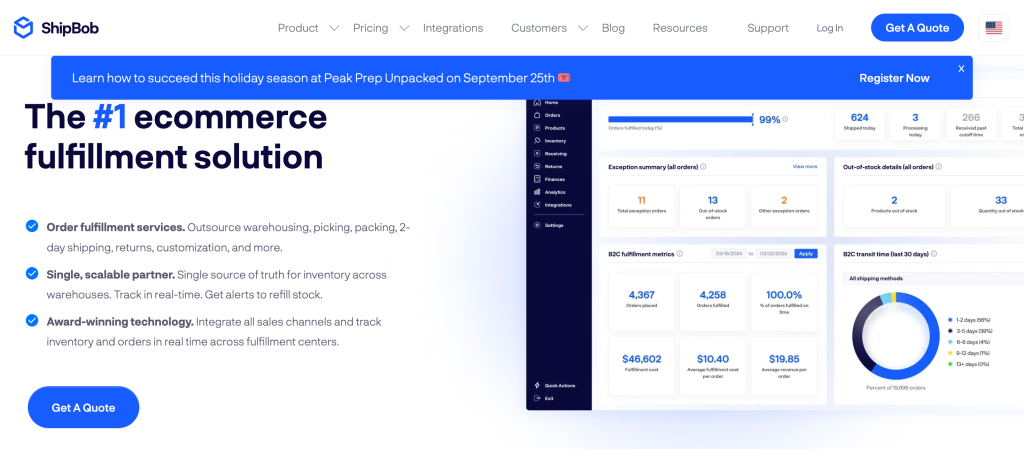
ShipBob is one of the biggest names in the space. They are a tech-first 3PL with a massive global network of over 50 fulfillment centers. They are built for Shopify brands that are growing fast and want to offer Amazon-level 2-day shipping everywhere.
ShipBob’s main strength is its huge global network, with warehouses across the US, Canada, Europe, and Australia. Their proprietary software is easy to use and provides deep insights. They also integrate easily with other channels like Amazon, TikTok Shop, and wholesale.
Things to Know: Their pricing is customized. They are best for brands shipping at least a few hundred orders per month and serious about expanding globally.
3. ShipMonk – Best for Returns
Best for: Startups and Subscription Boxes
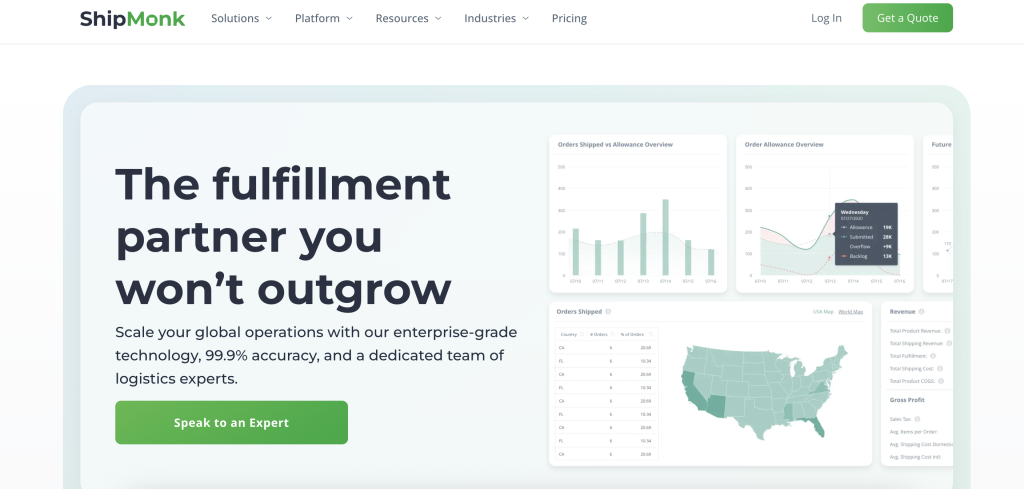
ShipMonk’s direct Shopify integration synchronizes products, orders, inventory, and tracking information. Their platform is built for direct-to-consumer brands, with detailed workflows for product bundles, subscription orders, and seasonal peaks.
Returns are a stronger part of ShipMonk’s service than they are with basic fulfillment companies. Merchants can set rules for refunds, exchanges, store credit, inspection, and restocking while keeping return activity tied to Shopify inventory.
This makes ShipMonk a practical choice for apparel, beauty, subscription, and lifestyle brands with regular return volume.
Things to Know: They have 12 locations, including the US, Canada, Mexico, and Europe.
3. eFulfillment Service -Best for Small Shopify Stores –
Best for: Small-to-Medium Businesses (No Minimums)
eFulfillment Service has no setup fees, integration fees, monthly order minimums, or long-term contracts.
Shopify stores pay for storage, order processing, and shipping based on account activity, which reduces the financial barrier for merchants with low or unpredictable volume. This structure works well for startups, side businesses, crowdfunding campaigns, and small stores moving away from home-based fulfillment.
The lack of a monthly order minimum also means a merchant doesn’t need to inflate sales projections to qualify for service.
Things to Know: They are a fantastic, reliable choice if you are just starting to outsource and feel overwhelmed by the giant, tech-focused 3PLs.
5. Shopify Fulfillment Network – Best for Shopify and Multichannel Selling
Best for: Shopify-First Brands
Amazon Multi-Channel Fulfillment (MCF) uses Amazon fulfillment centers to ship orders placed outside Amazon, including purchases from Shopify stores. Shopify merchants don’t need to list the product on Amazon, though an Amazon Seller Central account is required.
Amazon MCF supports priority, expedited, and standard delivery speeds. Shopify lists delivery windows of one business day for priority service, two business days for expedited service, and three to five business days for standard service after shipment.
Amazon MCF has a tradeoff. Returns aren’t processed directly through every version of its Shopify app, so merchants should check the current return workflow or use a compatible third-party returns tool.
Things to Know: You have less control over which warehouse your products go to. It’s also only for businesses shipping from the US.
6. Amazon Multi-Channel Fulfillment – Best for Fast Shipping
Best for: Multi-Channel Sellers
Overview: Do you already sell on Amazon FBA? With MCF, you can use Amazon’s massive, fast fulfillment network to ship your Shopify orders. You send all your inventory to Amazon, and they fulfill orders from all your channels.
Features: You get access to Amazon’s incredible 1-day, 2-day, and standard shipping speeds. It also allows you to manage your Shopify and Amazon inventory in one place. It’s one of the most reliable fulfillment networks on earth.
Things to Know: Your packages may arrive in Amazon-branded boxes, which some brands do not like. There are apps to connect your Shopify store directly to MCF.
7. ShipHero – Best for High-Volume Shopify Stores
ShipHero combines outsourced fulfillment with warehouse management software built for growing and high-volume merchants. Its Shopify connection supports inventory tracking, multi-location stock, barcode scanning, order rules, and tracking updates.
The system can group orders by status, prioritize urgent shipments, and handle orders split across several packages. ShipHero also states that its software serves a portion of Shopify Plus stores, which aligns the platform more closely with merchants managing high order counts and detailed warehouse workflows.
Smaller stores should compare monthly costs and operating requirements before choosing it over a simpler provider.
Best for: Tech-Focused Brands and Warehouse Management
Things to Know: They have a network of 7+ warehouses in the US and Canada.
How 3PLs Fulfill Your Shopify Orders
The Integration
First, you connect your 3PL partner to your Shopify store. This is almost always done through a simple Shopify App. This one-time setup syncs your product catalog (your SKUs) and tells the 3PL how much inventory you have.
A Customer Places an Order
A customer visits your site, adds a product to their cart, and clicks “Buy.” Shopify processes the payment and creates a new order in your admin, just like normal.
The Order Is Sent to the 3PL
Instantly and automatically, the Shopify integration sends this new, paid order to the 3PL’s Warehouse Management System (WMS). You don’t have to do anything. The order is now in the warehouse’s queue, ready to be picked.
The Order Is Picked and Packed
A warehouse team member receives the order on a mobile scanner. The scanner tells them the exact location of the items (e.g., Aisle 10, Bin 05). They “pick” the items, scan the barcodes to ensure 100% accuracy, and take them to a packing station.
The Package Is Shipped
The order is packed securely (using your branded boxes, if you’ve provided them), sealed, and weighed. The 3PL’s system automatically shops for the best shipping rate (e.g., UPS Ground vs. USPS Priority) for that destination and prints the label. The package is now ready for the carrier to pick up.
The ‘Sync-Back’ Happens
This is the final, crucial step. The 3PL’s WMS automatically sends the tracking number back to your Shopify admin. This “sync-back” does two things:
It marks the order as “Fulfilled” in Shopify.
It adds the tracking number to the order details.
The Customer Is Notified
Because the order is now marked as fulfilled in Shopify, Shopify’s own system (or your email app like Klaviyo) automatically sends the “Your Order Has Shipped!” email to your customer, complete with the tracking link.
The entire process, from click to ship, happens without you ever touching a box or printing a label.
Core Services: What a Good 3PL Must Do
No matter who you choose, they must be experts at these five things. These are the fundamentals.
Receiving
This is more than just signing for a truck. A good 3PL will:
Verify Counts. Check the shipment against your packing list to ensure you were not shorted by your factory.
Inspect for Damage. Open boxes to check for damaged goods before they are put on the shelf.
Scan SKUs. Log every single item into their Warehouse Management System (WMS). A mistake at receiving means your inventory will be wrong from day one.
Warehousing
This is the safe and strategic storage of your products. A 3PL warehouse is not just a big room.
Strategic Storage. They store your fastest-selling items closer to the packing stations for speed.
Climate Control. Essential for food, supplements, or beauty products.
Security. 24/7 monitoring to protect your high-value inventory.
Inventory Management. Their WMS syncs with Shopify, so when you sell an item, your stock levels are updated automatically.
Picking and Packing
This is the core of fulfillment. When an order from Shopify hits their system:
Picking. A warehouse worker is given a list and “picks” the correct items for the order. Good 3PLs use efficient methods like batch picking (grabbing items for multiple orders at once) to keep costs low.
Packing. The items are securely packed in the most size-appropriate box (to save on shipping costs), taped, and a label is applied. This is also your last chance to make a brand impression.
Shipping
This is where 3PLs save you a lot of money.
Carrier Discounts. They ship millions of packages a year, so they get massive, pre-negotiated discounts from carriers like UPS, FedEx, DHL, and USPS. They pass these savings to you.
Automation. Their system automatically buys and prints the cheapest, fastest label for that order’s destination.
Tracking. The tracking number is automatically pushed from their system back to Shopify, which then notifies your customer.
Returns Management (Reverse Logistics)
The customer journey does not end at delivery. Handling returns is a huge headache for brands. A 3PL:
Receives the Return. Gives your customer a place to send their unwanted item.
Inspects and Grades. They open the package, inspect the item, and grade it (e.g., A-Stock: perfect, B-Stock: damaged box, Salvage: unusable).
Restocks or Disposes. Perfect items are put back on the shelf to be resold. Damaged items are handled based on your rules (disposed, set aside, etc.). This gets sellable product back into your inventory fast.
Extra Services: What a Great 3PL Can Do
Top-tier 3PLs offer more than just the basics. These value-added services (VAS) can help you scale and build your brand.
Kitting and Assembly: Do you sell a “Summer Glow Kit” with three different products? A 3PL can “kit” these items for you, pre-building these bundles so they are a single, ready-to-ship SKU. This also works for subscription boxes.
Custom Packaging: You want your customers to have a great unboxing experience. A great 3PL can use your custom-branded boxes, tissue paper, and thank-you cards.
Product Personalization: This is a high-end service. Some 3PLs (like Speed Commerce) have in-house teams to do custom embroidery, engraving, or monogramming right before the item is packed.
Freight Forwarding: Need to get your products from your factory in another country to the 3PL warehouse? Many 3PLs can help you manage this entire inbound freight process.
Section 321 Fulfillment: This is a key service for brands manufacturing overseas. A 3PL near the border (Canada or Mexico) can import your products under a US Customs rule called Section 321. This allows shipments valued under $800 to enter the US duty-free, saving you a massive amount on import taxes.
Customer Service: Some 3PLs offer to run your entire customer support team. Since they have direct access to order and shipping information, they can resolve customer issues (“Where is my order?”) instantly.
Factors Influencing Your 3PL Services Bill
3PL pricing can feel complicated. Let’s break down exactly what you are paying for. Most 3PL bills are made of a few key parts.
When you get a quote, look for these line items. A good partner will be transparent about all of them.
Initial Setup and Onboarding Fees
This is a one-time fee some 3PLs charge to set up your account, integrate your Shopify store, and learn your product catalog. Many modern 3PLs (like Speed Commerce) waive this fee to make it easier to get started.
Receiving Fees
This is the labor cost for the 3PL to accept your inventory from your factory or supplier. The warehouse team has to unload the truck, count every item, inspect for damage, and log every SKU into the warehouse management system (WMS). This is usually billed by the hour, by the pallet, or by the unit.
Storage Fees
This is the “rent” for your products. It’s the cost for the physical space your inventory occupies in the warehouse. This is typically billed monthly. Make sure to ask how it’s calculated:
Per Pallet: A flat rate for each pallet (a 4’x4′ space).
Per Bin: A small fee for each bin holding your items.
Per Cubic Foot: The most precise measurement, based on the total volume your products take up.
Fulfillment (Pick & Pack) Fees
This is the core labor cost for getting an order out the door. It’s what you pay for a warehouse worker to “pick” the items for an order and “pack” them in a box.
Some 3PLs charge a flat fee for the first item in an order (e.g., $3.00) and a smaller fee for each additional item (e.g., $0.50).
Others offer a simple, all-in-one flat rate per order.
Shipping Fees
This is the actual cost of postage from the carrier (like UPS, FedEx, or USPS). This is often the biggest part of your bill. The good news is that 3PLs ship millions of packages, so they get massive volume discounts. These savings are passed on to you and are often far cheaper than what you could get on your own.
Value-Added Services (VAS)
This is a catch-all for any extra work. If it’s not a standard, repeatable process, it’s a VAS. This includes:
Kitting: Putting multiple items into a single bundle or subscription box.
Custom Packaging: Using your branded boxes, tissue paper, or inserts.
Personalization: Custom engraving, embroidery, or gift notes.
These services are almost always billed separately, so be sure to get a quote if your brand requires them.
Account Management Fees
Some 3PLs charge a flat monthly fee for access to their software, customer support, or a dedicated account manager. Always ask if this is included or if it’s an extra charge.

Jennifer Bennett
Demand Generation Manager at Speed Commerce
Jennifer supports marketing and content initiatives at Speed Commerce, helping ecommerce businesses better understand fulfillment, shipping, and the operational strategies that support sustainable growth.