
In 2026, third-party logistics (3PL) are more important than ever in helping businesses manage their supply chains. The trade war and a looming recession create an even greater need to understand where this industry stands and may be heading. Whether you’re starting to outsource logistics or rethinking your current partnerships, understanding what’s happening right now can make all the difference.
At Speed Commerce, we’ve taken a close look at the latest trends shaping the 3PL world, things like market growth, e-commerce impacts, new technology, and what today’s consumers expect.
Who are we? Speed Commerce is an end-to-end provider of outsourced customer experience solutions for eCommerce retailers (including for Shopify and BigCommerce and more) as well as manufacturers, for close to 20 years. We grow our clients’ businesses by providing winning customer experience strategies such as 24/7/365 eCommerce customer service, order fulfillment, and warehousing – get a free quote from a fulfillment expert. Use our new tariff calculator, updated for 2025.
Steady Market Growth
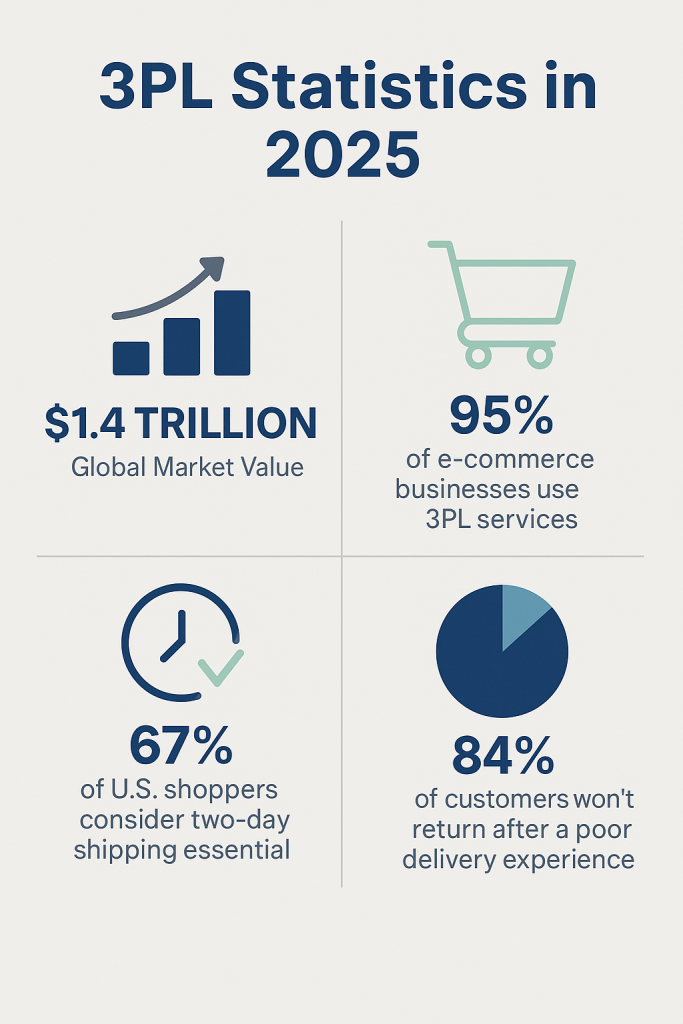
Right now, the global 3PL market is booming, set to reach around $1.3 trillion this year (S&P Global). Analysts expect it to keep growing steadily through 2030. In the U.S., the market has recovered strongly from the pandemic and is worth close to $307 billion and net revenue $131.5B (gross includes purchased transportation – source: Penske).These figures show just how crucial 3PL services have become, moving beyond basic transport solutions to becoming key strategic partners.
E-commerce as The Driving Force
Online shopping continues to push demand for 3PL services to new heights:
- Around 95% of online retailers now use 3PL providers.
- Many 3PL providers see nearly 70% of their business coming from e-commerce.
- Even big companies, like 90% of the Fortune 500, rely heavily on 3PLs for fulfillment.
As online shopping becomes standard, customers expect faster and more reliable service, making strong 3PL partnerships more essential than ever.
What Do Customers Expect Today?
Shoppers now want quick, affordable, and hassle-free deliveries:
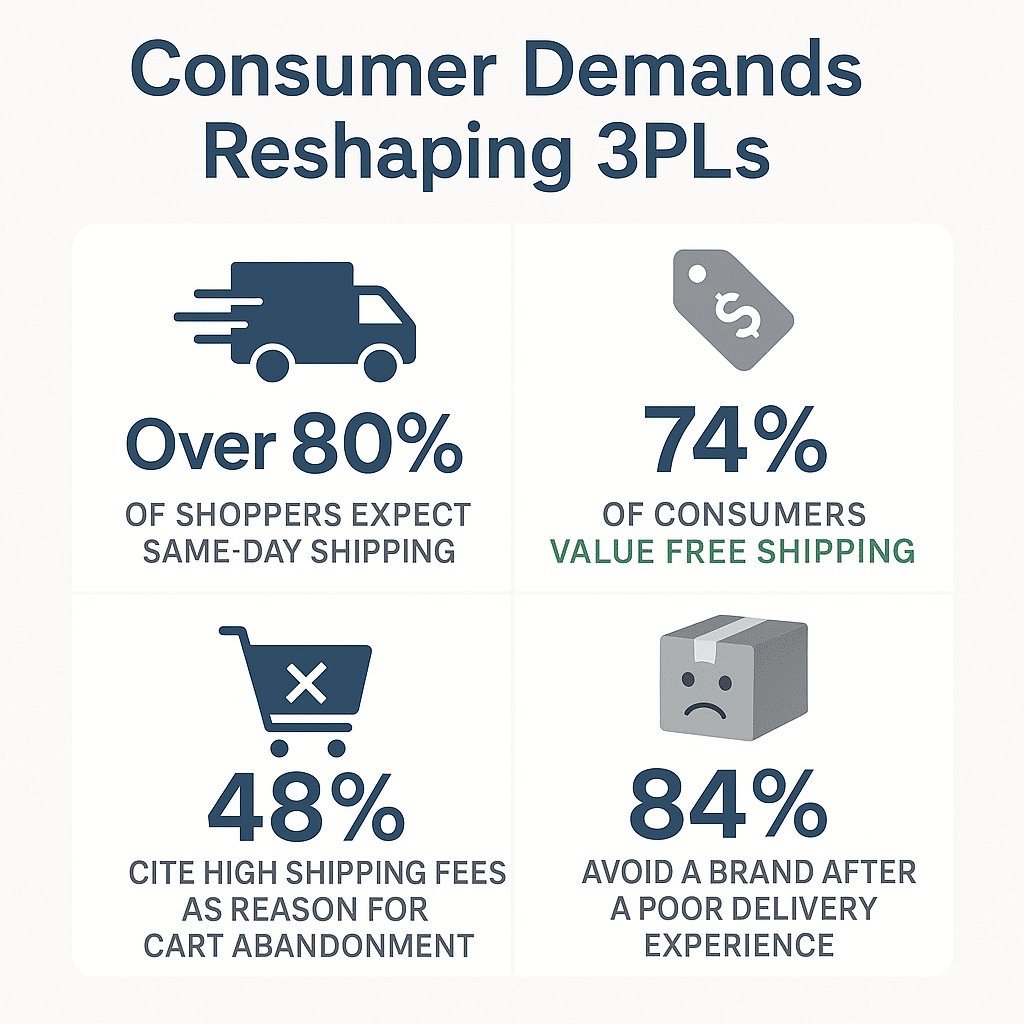
- Over 80% prefer same-day shipping, and two-day delivery is the new normal.
- Free shipping is almost not an option, with ~40% of shoppers abandon carts if fees are too high.
- Just one bad delivery experience means 84% of customers won’t shop with that brand again.
Your choice of a 3PL partner directly affects how happy your customers will be, and whether they’ll keep coming back.
The Tech Advantage
Technology continues to transform 3PL operations, enhancing speed and reliability:
- Nearly half of warehouses now use automation, making them more efficient.
- AI and machine learning have become key tools, with nearly half of logistics firms adopting them.
- Most leading 3PLs have advanced systems that offer real-time tracking and predictive insights.
These tech improvements mean faster orders, accurate inventories, and better overall service.
Same-Day Delivery: Becoming The Expectation, Not the Exception
Fast shipping is what customers now expect:
- Over half of U.S. retailers currently offer same-day shipping, and many more plan to follow.
- Offering same-day delivery can dramatically increase sales conversion rates.
To meet this demand, 3PLs are moving closer to customers and teaming up with quick-delivery services.
Facing the Industry’s Challenges
Despite growth, the industry deals with significant issues:
- Labor shortages continue to affect warehouses and transport efficiency.
- Rising costs and limited warehouse availability create operational stress.
- Keeping up with technology investments can be challenging but essential.
Knowing these challenges helps businesses set realistic expectations and choose the right logistics partners.
3PL Trends As It Relates to the Tariff-Led Trade War
The logistics world braced for impact as the 2025 tariff-led trade war brought brand new challended. With the U.S. poised to impose sweeping new tariffs (25% or more) on imports from Mexico, Canada, and China, businesses are scrambling to rethink supply chains. The ripple effects are already reshaping the third-party logistics (3PL) industry, which now stands at the center of a storm that could tip multiple economies into recession.
- De minimis is no longer a “background rule”: the White House issued an executive order suspending duty-free de minimis treatment (with CBP publishing importer guidance). That alone can reshape low-value ecommerce flows and the need for domestic inventory (Yahoo Finance).
- Legal uncertainty is part of the story as the Supreme Court agreed to hear a case tied to tariffs imposed under IEEPA, which adds real “rules might change again” risk for planning (Holland & Knight).
- Mexico is tightening loopholes and raising barriers: Mexico increased tariffs on certain textile/apparel imports and restricted IMMEX for finished apparel/textiles, explicitly targeting abuse patterns tied to cross-border ecommerce.
- Mexico’s Senate approved tariff hikes (up to 50%) on some Asian imports beginning 2026, which can push more transloading, reclassification scrutiny, and alternate sourcing decisions.
Bonded Warehousing Surges in Popularity
One of the fastest-growing trends is the use of bonded warehouses – secure storage facilities where imported goods can be held without paying duties until they enter domestic circulation.
Why It Matters:
- Duty Deferral: Importers can delay tariff payments indefinitely, gaining cash flow flexibility in a volatile market.
- Inventory Control: Goods can be stored, inspected, repackaged, or relabeled before re-export, helping companies hedge against shifting trade policies.
- Strategic Positioning: Many U.S.-based 3PLs are expanding bonded capabilities near ports of entry like Laredo, Los Angeles, and Newark.
Bonded warehousing isn’t new, but it’s experiencing a renaissance. As one logistics CEO recently put it: “Bonded facilities are becoming the ‘safe rooms’ of international trade.”
Nearshoring, Friendshoring & Regionalized Logistics
U.S. tariffs on Chinese imports and potential retaliatory tariffs from Mexico and Canada are pushing companies to diversify their sourcing, not only away from China, but toward friendlier nations or domestic manufacturing.
How 3PLs Are Adapting:
- Expanding Warehousing in Mexico (despite new tariffs) to serve maquiladora operations under IMMEX rules.
- Investing in Central America as an emerging nearshore alternative for apparel, electronics, and food goods.
- Doubling Down on U.S. Fulfillment to support reshoring efforts in key sectors like automotive, medical, and consumer goods.
This regionalization is pushing 3PLs to develop multi-node fulfillment networks, blending cross-border trucking, last-mile delivery, and local returns handling. Flexibility is becoming the most valuable asset in logistics.
Spike in Demand for Cross-Border Expertise
With the U.S.–Mexico–Canada (USMCA) trade framework under strain, importers are urgently seeking help to navigate new compliance hurdles.
3PL Services on the Rise:
- Customs Brokerage & Tariff Classification
- Duty Drawback Services
- Section 321 Clearance Alternatives
- Cross-Docking & Transloading at Border Zones
Expect to see a boom in third-party trade compliance outsourcing, as businesses seek to avoid missteps in a quickly shifting regulatory environment.
eCommerce Fulfillment Costs Are Rising
eCommerce brands, especially those relying on low-cost overseas manufacturing, are getting hit hard. Tariffs are increasing per-unit landed costs, making free shipping and fast delivery models harder to sustain.
The Fallout:
- Increased Demand for Domestic 3PLs to shorten lead times and avoid import costs.
- More Interest in Zone Skipping & Regional Hubs to control last-mile delivery expenses.
- Reassessment of Subscription Boxes, FBA Models, and D2C Brands built on wafer-thin margins.
One apparel executive warned that “Tariffs could kill the fast fashion business model if we don’t find fulfillment partners with smarter workarounds.”
Global Slowdown? 3PLs Are Hedging Bets
A prolonged trade war could easily tip the U.S., Canadian, or even Chinese economies into recession. That’s pushing many 3PLs to:
- Diversify their client base, moving into pharmaceuticals, defense, and food logistics.
- Automate low-margin tasks to preserve profitability during demand dips.
- Invest in predictive analytics to better anticipate inventory shifts and customer needs.
Public 3PL firms are warning investors of revenue headwinds tied to tariff shocks and global uncertainty. Some analysts expect M&A activity in logistics to spike again as smaller firms look for strategic exits.
Why It Matters to You
Choosing the right 3PL partner gives you clear business advantages:
- Quickly adapt your logistics without heavy investments.
- Take advantage of your 3PL partner’s scale and efficiencies.
- Benefit from specialized logistics knowledge.
- Consistently deliver on promises of fast, reliable shipping.
At Speed Commerce, we’re here to simplify your logistics challenges with smart technology, strategic planning, and sustainability at the forefront. Our simple goal is to turn your logistics into one of your strongest competitive edges.