
End-to-End WooCommerce Fulfillment Guide: What You Need to Know
Selling on WooCommerce requires understanding several elements, from setup to ongoing management.
As an open-source platform for WordPress, WooCommerce is a highly customizable eCommerce platform so users can control every aspect of their online store, from design to checkout processes.
For WooCommerce sellers, investing in third-party logistics (3PL) services can help with scaling efficiently while maintaining a positive customer experience. 3PLs handle warehousing, picking, packing, and shipping, so WooCommerce store owners can focus on growth rather than logistics. This is especially valuable as order volumes increase.
Looking for a better Woocommerce fulfillment solution?
A fulfillment expert will get back to you within 1-2 business days.
What Is WooCommerce?
WooCommerce is an open-source eCommerce plugin designed for WordPress. With WooCommerce, website owners can create, manage, and customize online stores easily. WooCommerce itself is free, though additional features may require paid plugins.
Developed in 2011 by WooThemes and later acquired by Automattic (the parent company of WordPress.com), WooCommerce quickly became one of the most popular eCommerce solutions globally. It’s renowned for its flexibility, scalability, and compatibility with WordPress.

WooCommerce Top Features
Below are the different WooCommerce features that businesses can access:
- Customization Features. WooCommerce offers a high degree of customization. Users can modify nearly every aspect of their store, from product pages to checkout flows. Additionally, there are thousands of themes and extensions available for free.
- Product Management. WooCommerce allows for easy product listing and categorization, supporting physical, digital, and even subscription-based products. It also supports product variations, inventory management, and shipping options.
- Extensive Plugin Library. WooCommerce can be extended with various plugins such as advanced analytics, marketing tools, payment gateways, and more. Users can also integrate WooCommerce with other third-party services, including accounting, marketing, and inventory management systems.
- SEO and Marketing Tools. Since WooCommerce is built on WordPress, it benefits from the platform’s SEO strengths and plugin availability. Additionally, it provides tools for upselling, cross-selling, discount codes, and email marketing.
- Mobile Responsiveness. WooCommerce sites are mobile-friendly, ensuring a smooth shopping experience across devices.
WooCommerce: Statistics and Growth
WooCommerce has established itself as one of the most popular eCommerce platforms globally, powering about 9.2% of all websites and approximately 13.1% of websites that use content management systems.
With an estimated 7.2 million active stores by the end of 2023, WooCommerce experienced an 18% growth in active stores compared to the previous year. Its popularity spans internationally, supported by multilingual capabilities in 67 languages and a major market presence in countries like the United States, the UK, India, and Germany. In the U.S. alone, over 2.5 million WooCommerce stores are currently in operation.
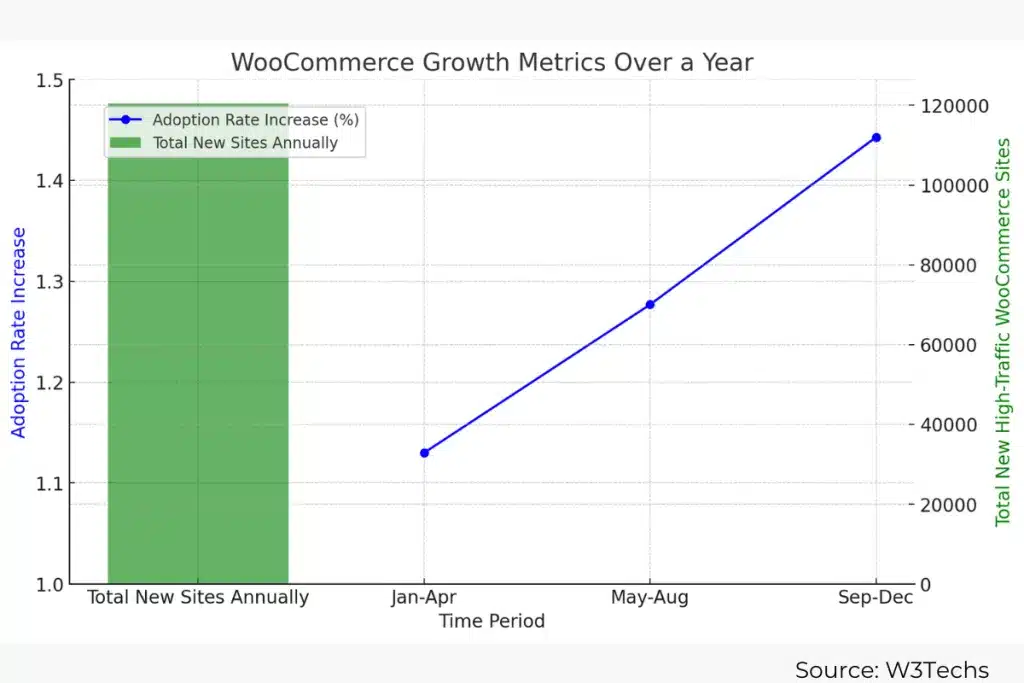
WooCommerce’s growth remains steady, with adoption rates increasing by approximately 13-15% every four months.
Roughly 330 new WooCommerce sites enter the top 10 million websites daily. This amounts to over 120,000 high-traffic sites each year.
Master WooCommerce Fulfillment From Start to Finish
request a quoteThe Latest WooCommerce News 2025
Explore the latest news highlights on advancements in the WooCommerce market and logistics below.
January
- Paymob has partnered with WooCommerce as its first preferred partner in MENA. This integration embeds Paymob’s checkout solution into the WooCommerce Marketplace, allowing merchants to access over 50 global and local payment methods, including Apple Pay and Google Pay.
July
- WooCommerce Partners with Elavon to Simplify Payment Processing and Help U.S. and Canadian Merchants Scale. The expansion brings Elavon’s reliable payment solutions to WooCommerce merchants in North America. The partnership aims to support micro, small, and medium-sized businesses (SMBs) by offering value-added services as their businesses grow.
Reference: “Elavon and Woo expand payments partnership to North America” (https://woocommerce.com/posts/elavon-and-woo-expand-payments-partnership-to-north-america/#section-1)
Why Use WooCommerce?
WooCommerce is a eCommerce platform for WordPress users who aren’t experts in online shop management. Here are the benefits of using WooCommerce:
Widespread Popularity and Market Share
WooCommerce powers about 9.2% of all websites globally, making it one of the most popular eCommerce platforms.
It holds around 25% of the global eCommerce market share, often rivaling major platforms like Shopify and Magento.
With an estimated 7.2 million active stores in 2023, WooCommerce continues to grow rapidly and attract a diverse range of online businesses.
Free and Open-Source
WooCommerce is free to use and modify as an open-source plugin, giving businesses complete control over their site. This open-source nature attracts both small businesses and developers who want a customizable, scalable solution.
Easy Integration with WordPress
WooCommerce is built specifically for WordPress, integrating seamlessly with the CMS and enabling users to add extra functions with ease.
Customizable and Flexible
As a platform, WooCommerce is highly customizable. It’s easy for business owners to set up, design and manage their own WooCommerce store so it fits their brand and meet their specific needs.

What Is WooCommerce Fulfillment?
WooCommerce Fulfillment refers to the process of managing and completing customer orders for WooCommerce-based online stores. This includes everything from receiving orders and preparing them for shipment to delivering them to customers.
WooCommerce itself does not directly offer fulfillment services (like warehousing, packaging, and shipping), but it does provide integrations and partnerships with third-party fulfillment services.
For example, WooCommerce has a shipping extension called WooCommerce Shipping, which helps with some fulfillment tasks, such as printing discounted shipping labels for carriers like USPS and DHL right from the WooCommerce dashboard. While it doesn’t handle warehousing or packaging, it simplifies the shipping process by allowing store owners to generate and print labels, and track shipments.
WooCommerce supports dropshipping through plugins like AliDropship and WooDropship. These plugins connect WooCommerce stores to suppliers, automating order placements and allowing suppliers to ship products directly to customers.
Unlike regular fulfillment services, WooCommerce store owners do not handle nor own physical inventory, packaging, or shipping.
Learn Only From The Best
request a quoteThe WooCommerce Order Fulfillment Process
Here’s a breakdown of how WooCommerce processes orders:

Step 1. Order Confirmation
When a customer places an order on a WooCommerce site, the order information is recorded in the WooCommerce dashboard. The store admin receives a notification and can view the order details, including customer information, product details, and payment status.
Step 2. Inventory Deduction
WooCommerce automatically deducts the ordered product quantity from the inventory, helping prevent overselling and keeping stock levels accurate. If an item is out of stock, WooCommerce can prevent new purchases, or store owners can choose to allow backorders.
Step 3. Packing and Labeling
The next step is packaging the order. Some WooCommerce stores handle this in-house, while others integrate with third-party fulfillment providers (3PLs) like ShipBob or ShipStation, which automate and manage the packing process. Shipping labels are generated manually or via plugins that integrate with major carriers (e.g., USPS, FedEx, UPS).
Step 4. Shipping and Tracking
Once packed, the order is handed over to the chosen shipping carrier. WooCommerce can be integrated with shipping plugins that provide real-time shipping rates, automatically generate tracking numbers, and send them to customers. These plugins help automate the shipping process and keep customers informed of the status of their orders.
Step 6. Order Tracking
After shipping, the order status in WooCommerce is updated to “Completed.” Customers are notified of the shipping status, often with a tracking link, enabling them to monitor their shipment. WooCommerce’s email notification system sends these updates automatically.
Step 7. Returns Management
WooCommerce does not have built-in return management, but plugins or integrations with 3PLs can handle return orders, providing customers with an easy way to initiate returns.
Challenges in WooCommerce Fulfillment
While WooCommerce is equipped with features that assist with order fulfillment, store owners may still encounter challenges in the following areas:
Inventory Management
Managing inventory as a WooCommerce seller becomes more complex, especially when handling multiple product variants, warehouses, or sales channels.
WooCommerce’s basic inventory tools are limited, which can lead to issues like overselling, stockouts, or inconsistencies in stock levels across locations.
Order Processing Speed
For stores processing a high volume of orders, manually managing each order in WooCommerce’s dashboard can be time-consuming and error-prone. This bottleneck can delay fulfillment, especially during peak seasons.
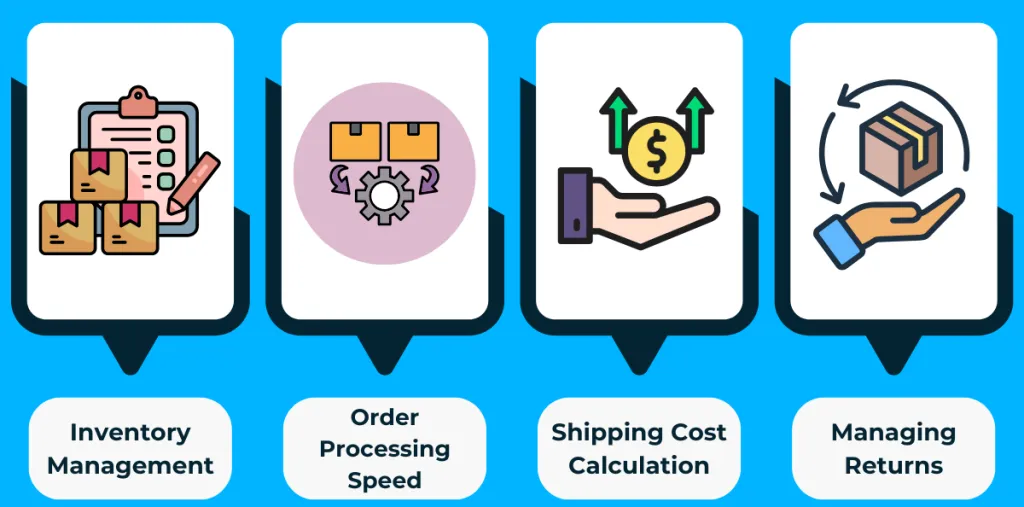
Shipping Cost Calculation and Optimization
WooCommerce’s standard shipping options are limited in flexibility, making it challenging to offer accurate and competitive shipping rates, particularly for international orders or variable-weight items.
Inaccurate shipping calculations can lead to unexpected costs, either for the customer or the business.
|
Basic Shipping Cost Formula: Shipping & Handling Costs = Packaging cost (P) + Shipping cost (S) + Handling Costs (H) |
Managing Returns
WooCommerce lacks a streamlined system for handling returns and exchanges. This means that it is significantly difficult for store owners to manage refunds, restocking, and customer communication. This can result in delays, errors, and customer frustration.
Step Up Your WooCommerce Fulfillment Game
request a quoteWhy Should You Outsource WooCommerce Fulfillment Services?
Below are the reasons why outsourcing might be the best choice for WooCommerce store owners:
Improved Shipping Speed and Efficiency
3PLs operate fulfillment centers in strategic locations across the country or even globally. This way, inventory is closer to customer regions which can reduce the time it takes for orders to reach customers.
In addition, fulfillment providers typically have established partnerships with multiple shipping carriers, like UPS, FedEx, DHL, and USPS. Their software often automatically selects the most efficient and cost-effective carrier based on destination, package size, and delivery speed requirements.
Lower Overhead Costs
WooCommerce fulfillment services can significantly lower overhead costs by reducing or eliminating expenses associated with in-house fulfillment operations.
Here are the primary overhead costs that outsourced fulfillment can help cut down:
- Warehouse Space and Utilities – WooCommerce store owners no longer need to maintain their own warehouse space. 3PLs manage inventory storage across multiple clients, so businesses only pay for the space they use.
- Labor Costs – Fulfillment providers handle staffing, training, and managing labor fluctuations. Store owners pay for services based on order volume rather than maintaining a full-time fulfillment team.
- Packing Materials and Supplies – 3PLs often buy packing materials in bulk at discounted rates, which reduces the cost per unit. They include these materials in their service fees, allowing WooCommerce stores to avoid the hassle and costs of sourcing and managing packing supplies.
- Seasonal Storage and Labor Adjustments – 3PLs provide flexible storage and labor solutions that scale with demand. Instead of hiring temporary staff or renting extra space, businesses using outsourced fulfillment simply pay for the additional volume, which is generally more cost-effective than adjusting in-house resources.
Advanced Fulfillment Technology
3PL providers often utilize robust inventory management systems that sync directly with WooCommerce, updating inventory levels in real time. This means any sale, return, or restocking is immediately reflected in the WooCommerce store.
Many fulfillment centers also use barcode or RFID scanning to track items as they move through each stage of fulfillment (e.g., picking, packing, and shipping). Each item is scanned and recorded to make sure it matches the order details.
Easier International Expansion
WooCommerce 3PLs have systems in place to automatically generate the necessary customs documentation for international shipments, such as commercial invoices, harmonized tariff codes, and country-of-origin labels. They stay updated on international shipping regulations to ensure packages meet all compliance requirements. This reduces the risk of delays, fines, or returned packages.
WooCommerce Fulfillment Has Never Been Easier
request a quoteFrequently Asked Questions About WooCommerce Fulfillment
Q: How to fulfill an order on WooCommerce?
A: To fulfill an order on WooCommerce, store owners manage orders through the WooCommerce dashboard, where they can view and update order details. After a customer places an order, the order appears in the “Orders” section of the dashboard. Store administrators review the order, verify the payment, prepare the items for shipping, and then update the order status to “Processing” or “Completed” depending on their workflow. For shipping, users can either manually add tracking information or use integrated shipping plugins to generate labels and update the customer with tracking details.
Q: Does WooCommerce have an inventory management system?
A: WooCommerce offers a basic inventory management system that allows users to track stock levels for individual products. Inventory settings are accessible in the WooCommerce product editing screen, where users can specify stock quantities, enable stock status management, and set up alerts for low stock. However, this system is limited to product-level tracking without advanced features like multi-location inventory or demand forecasting which you can get with a 3PL partner.
Q: What is the best inventory plugin for WooCommerce?
A: One of the top inventory plugins for WooCommerce is TradeGecko (now QuickBooks Commerce). This plugin provides advanced features like multi-warehouse support, detailed sales analytics, and integration with other sales channels, making it suitable for businesses with complex inventory needs. Stock Sync is also popular, especially for those needing automated stock updates and synchronization with suppliers.
Q: How do I track inventory in WooCommerce?
A: Inventory tracking in WooCommerce is handled through the product settings, where users can enable stock management for each product. WooCommerce automatically updates stock levels when an order is placed, reducing the inventory count by the quantity sold. Users can set low stock notifications to receive alerts when stock reaches a specified level, ensuring timely reordering. For more robust tracking, businesses can also connect with a 3PL company.
Q: Does WooCommerce do fulfillment?
A: WooCommerce does not provide in-house fulfillment services. However, it integrates with third-party logistics (3PL) providers and fulfillment plugins. These integrations allow WooCommerce users to outsource storage, packing, and shipping to external providers, who manage the logistics on behalf of the store.
Q: What can’t you sell on WooCommerce?
A: WooCommerce generally allows the sale of most products but has limitations depending on legal regulations and WordPress hosting provider policies. Common restrictions include illegal items, substances regulated by law (such as drugs, firearms, and tobacco), and copyrighted or trademarked goods sold without authorization. Additionally, some hosting providers restrict adult content or hazardous materials.
Choose Speed Commerce for WooCommerce Fulfillment

Choosing Speed Commerce for WooCommerce fulfillment means partnering with a provider dedicated to delivering exceptional customer experiences.
Since day one, Speed Commerce has been acing fulfillment for WooCommerce orders. You can trust that each order is handled with precision and care by a dedicated team of fulfillment experts.
Our commitment to 24/7/365 customer service ensures that your customers are taken care of every hour of every day. Best of all, we offer top-tier customer service to guarantee that concerns and inquiries are handled in the best way possible.
Ready to level up your WooCommerce fulfillment strategy? Get in touch with us today!
Fulfill WooCommerce Orders Faster and Smarter With Speed Commerce
request a quoteMore WooCommerce Fulfillment Resources From Speed Commerce
WooCommerce
An open-source eCommerce plugin designed for WordPress.
Third-Party Logistics (3PL)
Outsourcing logistics and supply chain management activities to a provider.
Canada Fulfillment
The logistics process of storing, packing, and shipping eCommerce orders within or to Canada.
BigCommerce Fulfillment
The process of managing and delivering orders placed through BigCommerce stores.
